![Dojeong [Korea Quality] / 도정서원 [한국관광 품질인증]](http://tong.visitkorea.or.kr/cms/resource/58/3037058_image2_1.jpg)
Dojeong [Korea Quality] / 도정서원 [한국관광 품질인증]
19.9Km 2023-11-30
417 , Gangbyeon-ro, Yecheon-gun, Gyeongsangbuk-do
+82-10-3451-9900
Dojeong Seowon in Yecheon, Gyeongsangbuk-do, was built to honor Yakpo Jeong Tak, who saved the life of the famous Admiral Yi Sunshin back in the 1500s. Now a hanok stay, it has four guest rooms, including Gangdang, once used as a lecture hall by Joseon scholars; a pavilion called Eup-hojeong; and Dongjae and Seojae, which were once dormitories. Gangdang is a private house of about 100 square metres and is suitable for group travelers. Eup-hojeong stands on a bluff overlooking the stream. Dongjae and Seojae have their own bathrooms. Standing on the 2nd floor of the pavilion brings one to the view of the Naeseongcheon Stream flowing in an arc around the mountain.
Yeongju Museom Village (영주 무섬마을)
20.0Km 2021-08-24
31-12, Museom-ro 234beon-gil, Yeongju-si, Gyeongsangbuk-do
+82-54-638-1127
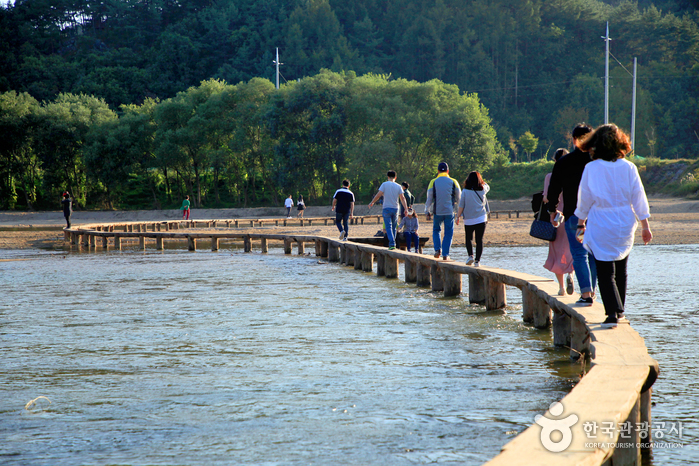
Located in Sudo-ri in Yeongju, Gyeongsangbuk-do, Museom Village is a charming hanok village surrounded by water. Flowing down from Sobaeksan Mountain and Taebaeksan Mountain, Naeseongcheon Stream and Yeongjucheon Stream converge and loop around Museom Village, surrounding the village on three sides with water. This peninsula-like village is not only the center of traditional Korean culture, but also has a gorgeous natural landscape complete with a wide sandy riverside and a lush inland forest.
Known for Haeudang and Manjukje Houses (two of the most historical hanok houses in the area), the village is also home to other outstanding traditional houses such as the Kim Gyu-jin House and the Kim Wi-jin House. Manjukje House is located at the heart of the village and the oldest traditional house in this hanok village. Manjukje was built in 1666 (7th year of King Heonjong's reign) by Bak Su (the father of the Bannam Bak Family).
Nearby Manjukje is Manun House, built in the early 19th century and named after Kim Hwi-geol (penname “Manun”). The house later became the home of the wife of the famous poet Jo Ji-hun, author of “Byeolli,” a poem expressing the beauty of Museom Village.
Other notable houses include the Kim Wi-jin House (a house belonging to aristocrats), the Kim Jeong-gyu House (a house without the traditional outer fencing), and the Bak Jae-yeon House, where the writings of Bak Gyu-su (a respected scholar during the Joseon period) still remain today.
Another famous attraction in the village is the Single Log Bridge, which was the village’s only connection to the outside world for over 350 years before the construction of Sudo Bridge in 1979. It is a tiny bridge in terms of x_width (30 cm), but it stretches for over 150 meters. It is said that the bridge was rebuilt annually after being destroyed each rainy season. With the construction of Sudo Bridge, the Single Log Bridge was no longer needed, but was rebuilt some time later in its original form. To celebrate the bridge’s impressive history, the village hosts the Single-Log Bridge Festival every October.
 English
 한국어
한국어 日本語
日本語 中文(简体)
 Deutsch
 Français
 Español
 Русский


