![Pinus Museum - Lotte Seoul Station Branch [Tax Refund Shop] (파이너스뮤지엄 롯데 서울역점)](http://tong.visitkorea.or.kr/cms/resource/86/2890086_image2_1.jpg)
Pinus Museum - Lotte Seoul Station Branch [Tax Refund Shop] (파이너스뮤지엄 롯데 서울역점)
2.4Km 2024-04-18
405, Hangang-daero, Jung-gu, Seoul
-

Rockport - Lotte Seoul Station Branch [Tax Refund Shop] (락포트 롯데 서울역점)
2.4Km 2024-04-22
405, Hangang-daero, Jung-gu, Seoul
-
![Kangol - Lotte Outlets Seoul Station Branch [Tax Refund Shop] (캉골 롯데아울렛서울역)](http://tong.visitkorea.or.kr/cms/resource/23/3314123_image2_1.jpg)
Kangol - Lotte Outlets Seoul Station Branch [Tax Refund Shop] (캉골 롯데아울렛서울역)
2.4Km 2024-06-27
405, Hangang-daero, Jung-gu, Seoul
-
![Xexymix - Lotte Outlets Seoul Station Branch [Tax Refund Shop] (젝시미스 롯데아울렛 서울역)](http://tong.visitkorea.or.kr/cms/resource/45/3313345_image2_1.jpg)
Xexymix - Lotte Outlets Seoul Station Branch [Tax Refund Shop] (젝시미스 롯데아울렛 서울역)
2.4Km 2024-06-26
405, Hangang-daero, Jung-gu, Seoul
-
![Black Yak [Tax Refund Shop] (블랙야크)](http://tong.visitkorea.or.kr/cms/resource/84/2890084_image2_1.jpg)
![Nepa [Tax Refund Shop] (네파)](http://tong.visitkorea.or.kr/cms/resource/37/2888437_image2_1.jpg)
![Vivien [Tax Refund Shop] (비비안)](http://tong.visitkorea.or.kr/cms/resource/67/2878567_image2_1.jpg)
![Venus [Tax Refund Shop] (비너스)](http://tong.visitkorea.or.kr/cms/resource/95/3314795_image2_1.jpg)
Olive Young - Seoul Station Branch [Tax Refund Shop] (올리브영 서울역점)
2.4Km 2024-06-27
405, Hangang-daero, Jung-gu, Seoul
-
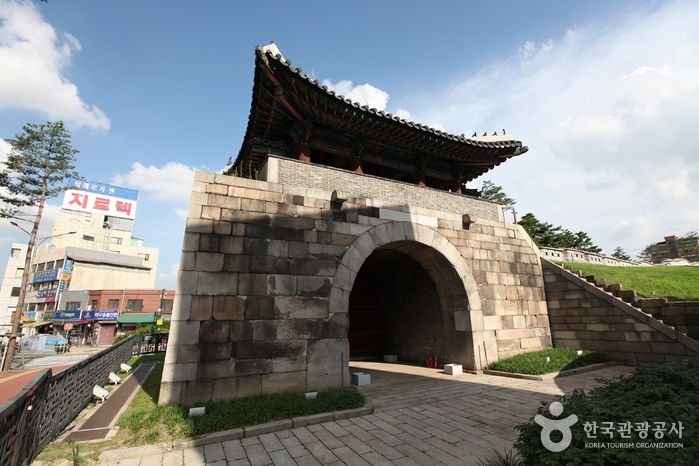
Gwanghuimun Gate (광희문)
2.4Km 2021-02-24
344, Toegye-ro, Jung-gu, Seoul
+82-2-3700-3900
Gwanghuimun Gate is said to have been originally constructed in 1396, the 5th year of King Taejo, at the southeast of the capital city. It was often referred to as Sugumun Gate (water channel gate) and was actually used as a Sigumun, literally meaning “corpse gate,” as funeral processions passed through this gate when exiting to the east.
During the Imjin War (1592-1598), the fortress gate was destroyed to such a degree that it made finding the original location close to impossible. Nevertheless, reconstruction efforts were started in 1711 (37th year of King Sukjong) and the gate was restored together with the gate's watchtower. Gwanghuimun Gate remained intact even when the fortress walls were demolished to build tram tracks during the Japanese occupation, but it was later damaged during the Korean War and left neglected. In 1975, restoration work was carried out to relocate Gwanghuimun Gate to a site 15 meters south of its original location since it stood in the middle of the road.
 English
 한국어
한국어 日本語
日本語 中文(简体)
 Deutsch
 Français
 Español
 Русский


