EL Hotel (이엘호텔) - Area information - Korea travel information

EL Hotel (이엘호텔)

EL Hotel (이엘호텔)

9.8Km    2024-12-19

3347 , Donghae-daero, Yangyang-gun, Gangwon-do
+82-33-673-3737

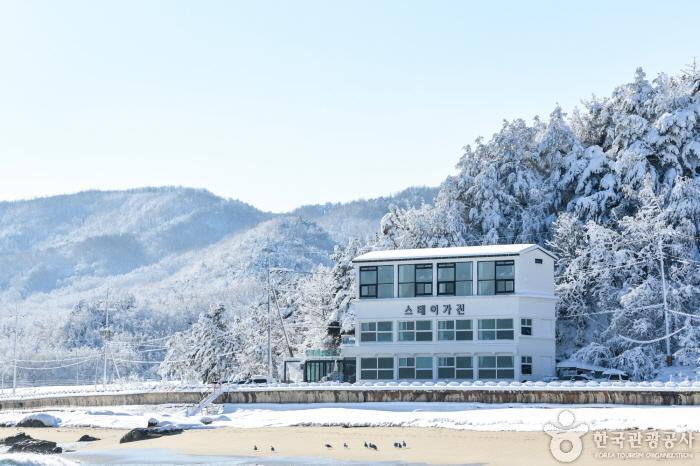
El Hotel on Jeongam Beach in Yangyang, Gangwon-do, has a great view over the beach and the East Sea. All guestrooms have beds and the Premier Suite and Family Suite also come with spacious living rooms. Each room has a vista, but the ocean view rooms are understandably the most popular. The 7th floor lounge restaurant also has a great sea view;  breakfast is served here in the morning, while in the evening it becomes a pub. Nearby tourist sites include Naksansa Temple, Naksan Beach, and Sokcho Daepo Port.

Baekchon Makguksu (백촌막국수)

Baekchon Makguksu (백촌막국수)

10.3Km    2024-12-10

Baekchon Makguksu is a one of the most well-known restaurant in Goseong for serving delicious makguksu (buckwheat noodles), a dish that defines Gangwon-do. Buckwheat noodles in Baekchon Makguksu are served with a dried pollack salad, which, for many regulars, is the thing that makes them come back for more. Baekchon Makguksu’s take on this dish combines the flavors of dongchimi (radish water kichmi) broth with Hamheung-style cold buckwheat noodles. Ingredients consist of dongchimi and buckwheat noodles, topped with dried pollack salad, sesame oil, vinegar, sugar, mustard, and seasoning to taste. The noodles themselves retain the fragrance and the texture of buckwheat quite well. Visitors who prefer their bowl to have a more subtle yet refreshing taste can control the amount of vinegar and seasoning to bring the soup’s flavors forward. Another popular dish here is suyuk (boiled pork slices). After enjoying a meal of makguksu, visitors are recommended to take a leisurely seaside stroll at the nearby Munamhaebyeon Beach.

Hujin Harbor (후진항)

Hujin Harbor (후진항)

10.5Km    2025-10-28

4-13Yongho-ri, Ganghyeon-myeon, Yangyang-gun, Gangwon-do

The first attraction Lee Know strolled to after unpacking. It's charmingly picturesque with its quaint view of red lighthouse overlooking the sea, anchored small boats, and a line of fresh seafood centers. On the second and fourth weekends, Beach Market attracts many visitors. Try to find the red chair where Lee Know sat in his vlog.

On the Button (온더버튼)

On the Button (온더버튼)

10.7Km    2024-12-27

On the Button is known for its view overlooking Munamhaebyeon Beach. The cafe’s facade features a window wall that brings the beach into view. The parking lot is located at the back of the cafe, so visitors won’t have to worry about cars blocking the view. With its chic interior and space, the cafe is also popular for photography. All beverages at On the Button are served in reusable cups. Lids are provided upon request. The second floor is a rooftop space. Children are prohibited from accessing the space due to safety reasons. The cafe serves a wide range of menu items, from Latte Verde to Summer Latte, Marron Latte, Cafe Americano, Latte, and Einspanner. Nearby tourist sites include Cheonhakjeong Pavilion, Baekdo Beach, and Gyoamri Beach.

Seorak Beach (설악해수욕장)

Seorak Beach (설악해수욕장)

10.8Km    2025-10-27

Dwinnaru 2-gil, Ganghyeon-myeon, Yangyang-gun, Gangwon-do

Known for its shallow waters and clean white sand, this beach is a sanctuary for surfers. It is conveniently located near famous tourist sites such as Seoraksan Mountain and Naksansa Temple, making it ideal for sightseeing. Just a five-minute walk from Hujin Harbor, go for a walk during sunset period like Lee Know and enjoy the beautiful sunset in the background.

Baekdohaebyeon Beach (백도해변)

Baekdohaebyeon Beach (백도해변)

11.3Km    2025-10-23

78 Baekdohaebyeon-gil, Jugwang-myeon, Goseong-gun, Gangwon-do

Baekdo Beach is a quiet, white sandy beach located north of Sokcho. The area around the beach features splendid natural landscapes including unique rock formations and lush forests of pine trees. The beach is in a crescent shape, with a red lighthouse standing on the righthand point. The shallow and clean waters make this popular among families.

Osaengnyeong (Hangyeryeong) Pass (오색령(한계령))

11.3Km    2021-04-12

Seo-myeon, Yangyang-gun, Gangwon-do
+82-33-672-2883

This 1,004 m-high pass connects Seo-myeon of Yangyang-gun and Buk-myeon and Girin-myeon of Inje-gun, at the border between Naeseorak and Namseorak. The people of Yangyang know the pass as Osaengnyeong, while in Inje it is known as Hangyeryeong. Yi Jung-hwan, a late Joseon period scholar and the author of the geographical text Taengniji (On Selecting a Village), counted Osaengnyeong Pass as the first and the foremost of the six famous passes in Gangwon-do. Indeed, Osaengnyeong Pass was the route through which essential supplies were transported from Yangyang (in Yeongdong) to Inje (in Yeongseo region), and the rough pass taken by the people of Yangyang on the way to Seoul. Its presence in the folklore of the region can be seen in the popular song Hangyeryeong, which speaks to the difficulties of those who had to climb the pass. Hangyeryeong Road was opened in 1981, and today’s National Road No. 44 is famous for being a driving course through the beauty of Seoraksan Mountain. This is also the starting point of the shortest route to Daecheongbong Peak, the highest peak in Seoraksan Mountain, and the trail to the summit of Jeombongsan Mountain.

Bongjeongam Hermitage (Inje) (봉정암(인제))

11.4Km    2024-02-28

1700 Baekdam-ro, Buk-myeon, Inje-gun, Gangwon-do

Bongjeongam Hermitage, situated at the highest point of Seoraksan Mountain, stands at 1,244 meters above sea level. Due to its elevation, one can witness snow-covered landscapes well into late May. The temple is 10.6 kilometers from the entrance of Baekdamsa Temple and requires 4-5 hours of steep climbing to reach. The view from Bongjeongam Hermitage is breathtaking, but the view of Seoraksan Mountain from the Shrine of Sakyamuni Buddha's Sarira is equally unmissable.

Naksansa Temple (낙산사)

11.5Km    2025-10-23

100 Naksansa-ro, Yangyang-gun, Gangwon-do
+82-33-672-2475

This ancient temple was built in the 11th year of King Munmu’s reign of Silla (671) by the Buddhist monk Uisang. Naksansa Temple is one of the foremost sights of Yangyang, and one of the most historic sites in the region. Along with Ganghwa’s Bomunsa Temple and Namhae’s Boriam Hermitage, it is said to be one of the three centers of the cult of Avalokitesvara in Korea. Its handsome view overlooking the East Sea has earned it a spot in the Eight Sights of Gwandong (eight famous sights in Yeongdong region of Gangwon-do), documented throughout the ages in many classic literature and poetry. Today’s Naksansa Temple is a product of many restorations and expansions, and has many examples of cultural heritage within its walls, including a 16 meter-tall statue of the Avalokitesvara Bodhisattva. A mountain fire in 2005 resulted in the loss of 20 buildings, including the building that housed its bronze bell. The temple also operates templestay programs available through its website.

Uisangdae Pavilion (낙산사 의상대)

Uisangdae Pavilion (낙산사 의상대)

11.6Km    2024-12-26

100 Naksansa-ro, Yangyang-gun, Gangwon-do
+82-33-672-2447

This pavilion is located on a seaside cliff on the way from Yangyang’s Naksansa Temple to Gwaneumgul Cave of Hongnyeonam Hermitage. The word “dae” in Uisangdae refers to a building built at a vantage point for areas with beautiful scenery. Indeed, the view of the East Sea and the coast from Uisangdae Pavilion awarded its recognition as one of the Eight Sights of Yangyang, and a must-visit place for all visitors to Naksansa Temple. Jeong Cheol (pen-name: Songgang), a famed scholar and writer of the poem Song of Diamond Mountains, chose the pavilion as one of the Eight Sights of Gwandong, and the pavilion is today one of the popular sites for sunrise-viewing on the east coast of Korea. Together with Hongnyeonam Hermitage, it is designated as the Scenic Site No. 27 of Korea under the name “Uisangdae Pavilion and Hongnyeonam Hermitage of Naksansa Temple, Yangyang.” Uisangdae is named after Uisang, a respected Silla-era Buddhist monk who is said to have founded this temple in 671 (11th year of King Munmu’s reign of Silla), and many stories of his deeds can still be found in the temple. For instance, Uisangdae is said to be the site where he meditated before founding Naksansa Temple at its present site. Today’s pavilion was restored to its present hexagonal form in 1995.