Choong Ang High School (중앙고등학교)
6.8Km 2025-10-23
164 Changdeokgung-gil, Jongno-gu, Seoul
+82-2-742-1321
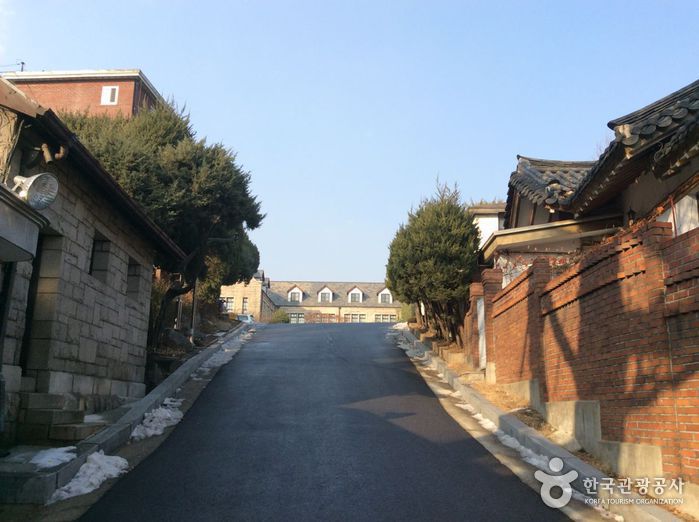
Choong Ang High School is located in Jong-ro near Samcheongdong-gil. It was built to educate the public at the beginning of the 20th century. The school’s main building was reconstructed in 1937 after the original two-story brick house was destroyed in 1934. The main building situated in front of the main gate is a two-story H-shaped granite stone building in Gothic style, with a four-story tower in the middle.
The school holds historical significance because it was designed by Park Dong Jin, one of Korea's first modern architects and the designer of Korea University’s main building, library, and the Chosun Ilbo Newspaper Company building. The main building of Choong Ang High School is designated as Historic Site No. 281. Many national leaders were educated at the gothic building during the grim period when Korea was trying to escape Japanese colonial rule.
Changdeokgung Injeongmun Gate (창덕궁 인정문)
6.8Km 2025-01-14
99, Yulgok-ro, Jongno-gu, Seoul
+82-2-3668-2300
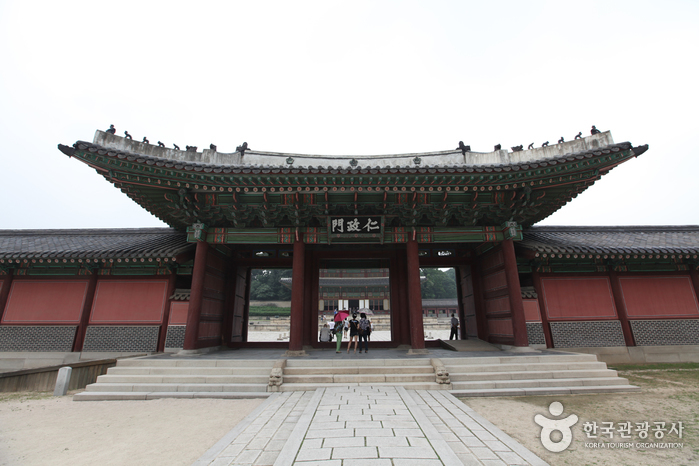
Serving as the main gate of Injeongjeon Hall, Injeongmun Gate was established in 1405 (5th year of King Taejo’s reign during the Joseon dynasty). Later on, the gate was destroyed by multiple fires during the Imjin War (Japanese invasion of Korea in 1592), therefore current form of the establishment displays designs that are more often seen in the late 19th century's. In addition, a lot
of subsidary marks and buildings are removed from the original places and relocated passing the time, however, still remains to represent prestigious ambience.
Injeongmun Gate served as the place for several coronation ceremonies of kings, prince's succession of throne, and many other national affairs celebrated by the royal members who gathered and aligned around this gate.

Leeum, Samsung Museum of Art (삼성미술관 리움)
6.8Km 2022-12-15
60-16, Itaewon-ro 55-gil, Yongsan-gu, Seoul
+82-2-2014-6901
Leeum, Samsung Museum of Art, exhibits traditional and modern art works by Korean and international artists. The museum itself is just as fascinating as the art works on display, since the museum's three buildings were designed by internationally renowned architects Mario Botta, Jean Nouvel, and Rem Koolhaas.
MUSEUM 1 houses traditional Korean art, such as calligraphy, paintings, ceramic arts, and metal craftwork, while MUSEUM 2 displays modern and contemporary art by both Korean and international artists.
Samcheong Park (삼청공원)
6.8Km 2024-03-18
44, Insadong-gil, Jongno-gu, Seoul
+82-2-2148-4150
Samcheong Park is a park that blooms in cherry blossoms in spring and fall colors in fall near Gyeongbokgung Palace. The park is home to a forest library and a café, and visitors can follow the trails to find acupressure trails, exercise equipment, badminton court, tennis court, playground, and a convenience store. The area surrounding the park is home to many galleries and restaurants, so it is a popular destination for walking among the people of Seoul.
Changgyeonggung Palace Honghwamun Gate (창경궁 홍화문)
7.0Km 2021-05-27
99, Yulgok-ro, Jongno-gu, Seoul
+82-2-762-4868
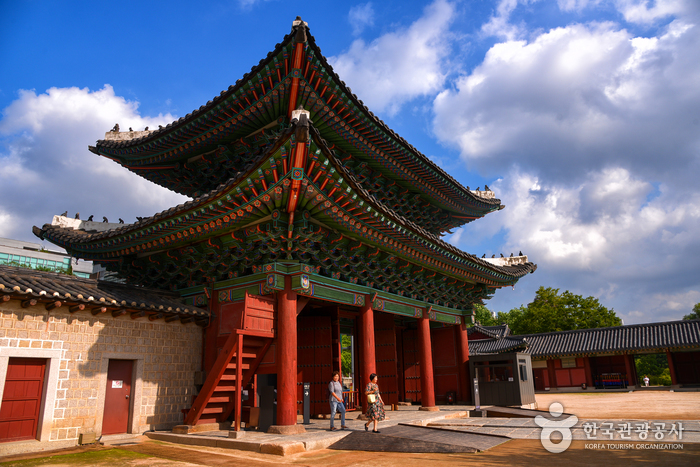
Honghwamun Gate is the main gate of Changgyeonggung Palace. It has three opening gates in the front and two to the side with a sophisticated locking mechanism.
Nakseonjae Hall (낙선재)
7.0Km 2021-09-30
99, Yulgok-ro, Jongno-gu, Seoul
+82-2-2148-1822
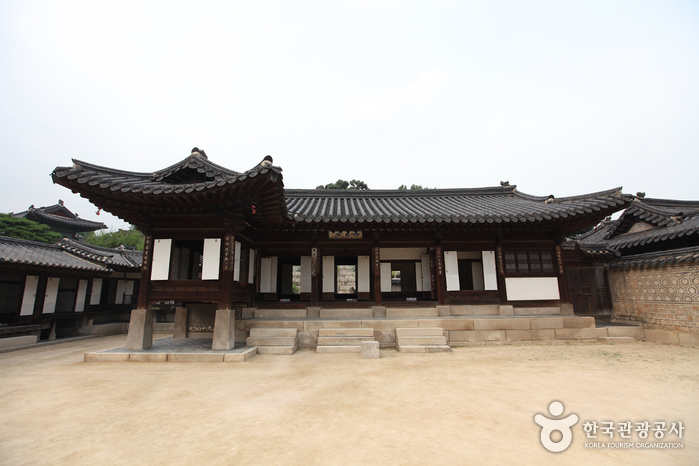
Located inside Changdeokgung Palace, Nakseonjae Hall is a one-story structure built in ikgong style (bird wing-shaped eaves placed on top of the pillars) with a hip tiled and gable roof. It has 6 kan in the front and 2 kan (traditional unit of measurement of the space between pillars) to the sides. It originally belonged to the nearby Changgyeonggung Palace, but came to be considered a part of Changdeokgung Palace in more recent years.
The hall was constructed in 1846 (12th year of King Heonjong’s reign) and it is collectively called Nakseonjae together with the adjacent Seokbokheon Hall and Sugangjae Hall.
Behind the building is a flower garden made of stacked large stones. The chimney, the flowers, and the oddly shaped stones harmoniously blend into one another to create an outstanding landscape gardening.
Seoul National Cemetery (국립서울현충원)
7.0Km 2024-03-07
210, Hyeonchung-ro, Dongjak-gu, Seoul
+82-2-813-9625
Seoul National Cemetery is a national cemetery for individuals who worked or fought for Korea and sacrificed their lives. It encompasses those who fought for Korea's independence from the late 19th century to the early 20th century, those who perished in the Korean War (1950-1953), and former presidents, totaling over 165,000 individuals. There are exhibition halls and parks with related artifacts. Shuttle buses are provided for the convenience of visitors.
![Series; Corner [Tax Refund Shop] (시리즈코너)](http://tong.visitkorea.or.kr/cms/resource/09/2891109_image2_1.jpg)
![Kolon Series; - Itaewon Branch [Tax Refund Shop] (코오롱 시리즈 이태원)](http://tong.visitkorea.or.kr/cms/resource/73/2889073_image2_1.jpg)
Kolon Series; - Itaewon Branch [Tax Refund Shop] (코오롱 시리즈 이태원)
7.0Km 2024-04-18
244, Itaewon-ro, Yongsan-gu, Seoul
-
Yejiwon (예지원)
7.0Km 2022-09-19
72, Jangchungdan-ro, Jung-gu, Seoul
+82-2-2253-2211
The Yejiwon is located in Seoul Jung-gu Jangchung-dong and has been offering traditional Korean etiquette education programs since its inception on September 16th, 1974. Furthermore, the Yejiwon also serves to introduce the traditional cultures and living cultures of Korean etiquettes to foreigners.
Most programs offered are short-term classes, and reservations can be made on the homepage up to 15 days in advance. Reservations are only available for groups of 10 or more and classes are instructed in Korean only, so it may be a good idea to be accompanied by a guide.
 English
 한국어
한국어 日本語
日本語 中文(简体)
 Deutsch
 Français
 Español
 Русский


