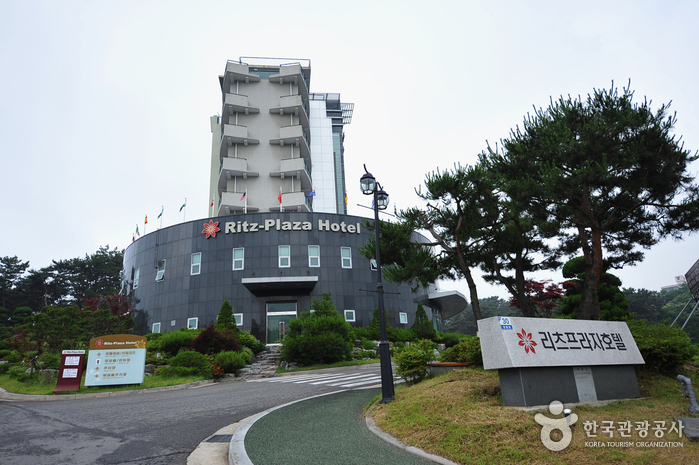
Ritz Plaza Hotel (리츠프라자호텔)
7.5Km 2024-04-07
30 Hanbatan-gil, Gunsan-si, Jeonbuk-do
Ritz Plaza Hotel is a tourist hotel perfect for leisure, well-being, and resting. It is a representative of Gunsan along with Seonyudo Island. The stunning Eunpa Lake can be seen from the premium rooms. The hotel is equipped with various facilities like a Korean restaurant, Western-cuisine restaurant, coffee shop, buffets, wedding hall, banquet hall, and cafe bar.
Eunpa Lake Park (Eunpa Recreation Area) (은파호수공원(은파국민관광지))
7.9Km 2024-04-07
Miryong-dong, Gunsan-si, Jeonbuk-do
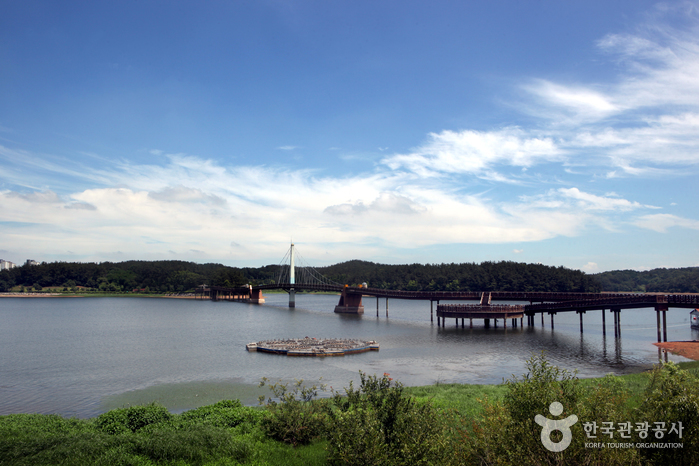
Located in Gunsan, Jeollabuk-do, Eunpa Lake Park was once a reservoir built before the Joseon dynasty that supplied water to nearby farms. The lake and its surrounding mountains were designated a national tourist site in 1985, but remain historically significant as they are featured on Daedongyeojido (Grand Map of Korea), a revered document developed by geographer Kim Jeong-ho. Known for its beauty at night, the lake was befittingly dubbed “Eunpa,” which means “silvery moonlit waves.”
Eupa Lake Park is full of natural beauty. The road that runs up from the park entrance is lined with cherry trees that create a breathtaking tunnel of pink flowers each spring. This stunning cherry blossom tunnel draws crowds of families and couples each year, particularly on the weekends. Mulbit Bridge, a landmark of the Eunpa tourist site, offers an impressive view of the Music Fountain and nightscape. At the park, you’ll also find an inline skating area, a waterfront stage, and a lotus flower garden.

Saemangeum Trail (새만금 광역탐방로)
10.4Km 2024-04-06
1192-1 Hwapo-ri, Jinbong-myeon, Gimje-si, Jeonbuk-do
Saemangeum Trail is a walking trail designed to showcase the exceptional natural scenery near the Mangyeonggang River. Spanning a total of 12.5 kilometers, starting from Mangyeong-eup's Tojeong Village and leading to Jinbong-myeon's Sampo Village, this trail allows walkers to immerse themselves in expansive rice paddy and lush greenery. Along the Mangyeonggang River, visitors can also observe various protected plant and animal species inhabiting the area.
Gimje Seongmoam Hermitage (성모암(김제))
11.1Km 2024-04-07
54-9, Hwapo3-gil, Gimje-si, Jeonbuk-do
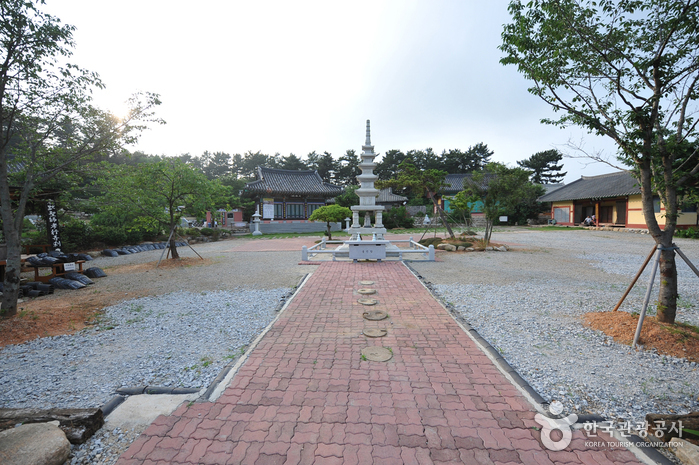
Seongmoam Hermitage, a temple of the Jogye Order, is located on Yuangsan Mountain in Mangyeong-myeon, Gimje-si. The temple is the final resting place of the mother of Jinmuk Daesa, a great Buddhist monk from the Jeonbuk region. Jinmuk believed that a person’s love and respect for Buddha is not that much different from the love and respect one has for his or her parents. As an expression of this philosophy, Jinmuk had his mother’s remains enshrined at the temple after she died at Mujasoncheonnyeonhyanghwajiji.
A neat little line of stone lamps leads visitors up from the parking lot to the temple grounds, revealing the well-attended grave of Jinmuk Daesa’s mother to the left. The temple is very unique in that it is the only one to house a caretaker’s office (Gosiraejoen Hall) that is responsible for maintaining the grave site.
It is said that prayers made to Seongmo (the holy mother) while visiting the temple will come true. Throughout the year, throngs of people journey to the temple to pay their respects and earnestly ask the holy mother to grant them their deepest desires.
Iksan Ipjeomni Ancient Tombs (익산 입점리 고분)
11.2Km 2024-04-07
80, Ipjeomgobun-gil, Iksan-si, Jeonbuk-do
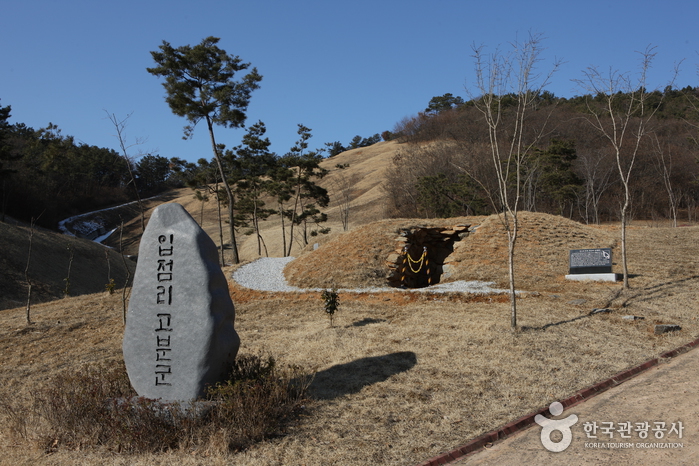
The Iksan Ipjeomni Ancient Tombs are a group of ancient Baekje-era tumuli located 100 meters above sea level on the northeast brow of Chilmokjae Hill in Ipjeom-ri, Iksan-si, Jeollabuk-do. The burial ground covers an area of more than 18,520 square meters and is officially listed as Historical Site No. 347. To date, a total of eight tumuli have been excavated, all of which are chamber tombs.
Surprisingly enough, the tombs were first discovered in 1986 by a high school student. While digging for arrowroot, a young man from a local high school found some pieces of gold that resembled a hat. He quickly notified the authorities and it was soon discovered that the pieces of gold were in fact valuable ancient artifacts. An emergency excavation was conducted and the eight tumuli were uncovered, but unfortunately all of the tumuli except Tomb No. 1 had been severely damaged. Tomb No. 1, which is still in relatively good condition, boasts an entrance measuring an impressive 16 meters in x_height and 2 meters in x_width.
Inside the tombs archaeologists found valuable relics from the Baekje dynasty including earthenware, jewelry (a gilt-bronze hat, gold earrings, glass beads, etc.), harnesses and ironware. Given the shapes and the types of the pieces found, historians estimate that the tumuli were built in the 5th century. Since the gilt-bronze hat is similar in shape to those found in Japan, experts believe that there was an active exchange between the Baekje people and the people of Japan.
Gunsan Country Club (군산 컨트리클럽)
13.7Km 2024-04-07
1685, Namgunsan-ro, Gunsan-si, Jeonbuk-do
Gunsan Country Club is a golf course featuring 81 holes, including 18 holes exclusively for members only, on the site of an abandoned salt field that spans over 1,060 acres. It is the only course in Korea where all the holes are surrounded by lakes; around 380 acres or 36% of the course is comprised of lakes, and the holes are connected by 26 bridges. It has some of the longest golf holes in the world, including a Par 7 hole (1,004 m) and a Par 6 hole (661 m). The 18-hole private golf course is done in the classic American style, while the public golf course offers more variety.
Manghaesa Temple (망해사)
14.6Km 2024-04-07
94, Simpo 10-gil, Gimje-si, Jeonbuk-do
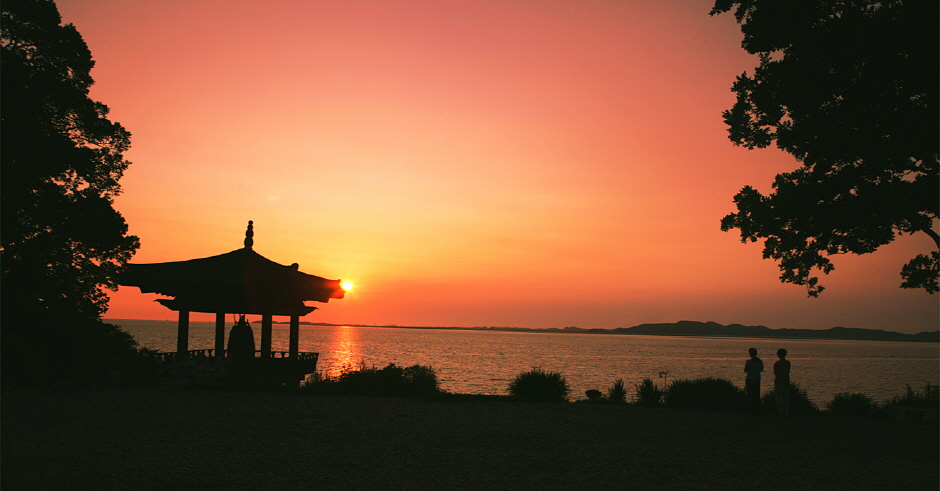
Manghaesa Temple is located at the edge of the Gimje Plains before the sea. The temple stands at the summit of Jinbongsan Mountain. The temple was named for the view of the ocean and the fields of rice. The temple was established by the great monk Buseol Geosa during the 2nd year of King Uija of Baekje (AD 642). Years later, Dobeopsa (a Chinese monk from the Tang dynasty) renovated the temple. The temple was altered again during the reign of King Injo of the Joseon dynasty when the great monk Jinmuk Daesa built Nakseojeon Hall in 1589. Bogwangjeon Hall and Chilseonggak Pavilion were built much later in 1933. Manghaesa Temple is unique in that it is the only temple where the distant horizon is visible over both land and sea. Nearby attractions include a walking path through a field of reeds by Mangyeonggang River and views of the sunset over the sea.
Yubudo Island (유부도)
15.1Km 2024-02-21
Yubudo-gil, Janghang-eup, Seocheon-gun, Chungcheongnam-do
Yubudo Island is a small island in front of Seocheon's coastline, accessible by ferry from Janghang Port in about 30 minutes. The island boasts extensive tidal flats and saltern developed with embankment. It is a place where saltwater and freshwater mix, making it abundant in fish like grey mullet and shrimp. Yubudo Island is also known as a resting spot for over 100 species of migratory birds.
Wonkwang University Hospital (원광대학교병원)
16.7Km 2025-10-23
895 Muwang-ro, Iksan-si, Jeonbuk-do (54538)
WONKWNAG UNIVERSITY HOSPTIAL leads the advancement of medical care in Jeollabuk-do by centering on excellent medical personnel and introducing the latest medical equipment.
We are the first in the Jeonbuk State to receive the KAHF (Korean Accreditation Program for Hospitals serving Foreign Patients). Our hospital is a tertiary hospital equipped with a Jeonbuk Regional Cardiocerebrovascular Disease Center, Trauma Center, Regional Emergency Medical Center, and a multi-person hyperbaric oxygen therapy chamber.
As a renowned cancer specialist, we have consistently attained the highest level, Grade 1, in all four major cancer care assessments (colon cancer and stomach cancer for 7 consecutive years, and breast cancer and lung cancer for 6 consecutive years) conducted by the Health Insurance Review and Assessment Service (HIRA). With a team of specialists dedicated to developing cancer treatments, it provides specialized cancer management service. In particular, we have established a collaborative treatment system essential for patients with severe cancer through multidisciplinary integrated treatment by internal medicine, surgery, rehabilitation medicine, and oriental medicine hospitals together, and performed cancer surgeries with a high degree of difficulty on a large number of patients every year.
Iksan Sungnimsa Temple (숭림사(익산))
16.8Km 2024-04-07
495-57, Baekje-ro, Iksan-si, Jeonbuk-do
Sungnimsa Temple is one of the major temples in Iksan under Geumsansa Temple and was believed by some to have been built by monk Jinpyo Yulsa during the reign of King Gyeongdeok (742-764) during the Silla period. Others believe that the temple was established during the first year of King Chungmok of the Goryeo dynasty in 1345. Sungnimsa Temple was named in honor of great monk Bodhi-Dharma, who practiced seated Zen meditation for nine years at Sorimsa Temple located deep inside Sungsan Mountain in China. The temple was burnt down during the Imjin War (1592-1598), leaving only Bogwangjeon Hall. Bits and pieces of the temple were later restored in 1697, 1819, and 1892.
 English
 한국어
한국어 日本語
日本語 中文(简体)
 Deutsch
 Français
 Español
 Русский


