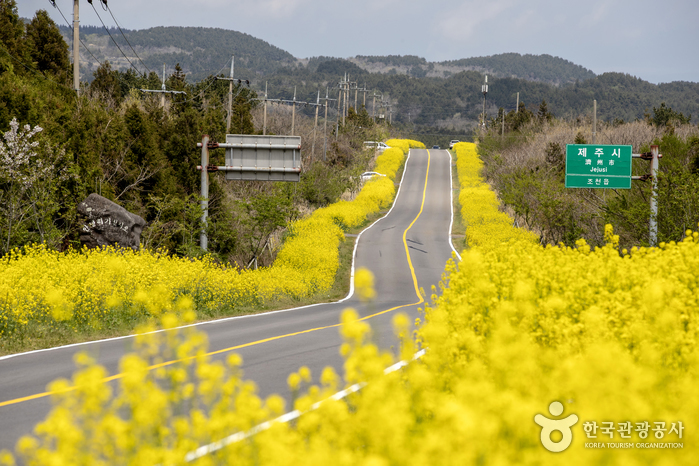
Seogwipo Gasiri Village (Noksan-ro Canola Flower Road) (서귀포 가시리마을 (녹산로 유채꽃도로))
15.8Km 2024-01-09
20 Gasi-ro 565beon-gil, Pyoseon-myeon, Seogwipo-si, Jeju-do
Seogwipo Gasiri Village is where canola flowers and cherry blossoms bloom simultaneously over a 10-kiliometer section from its access road every April, boasting a picturesque driving route. The combination of yellow canola flowers and light pink cherry blossoms is very special. Selected as one of the “100 Beautiful Roads in Korea,” Gasiri Noksan-ro Road is a road that passes through Noksanjang and Gammajang, which were the best horse farms of the Joseon period, and is currently one of the best canola flower roads in Jeju. As such, it is called the "First Sight of the Ten Sights of Gasiri Village." In addition, visitors can enjoy beautiful natural scenery unique to Jeju, such as Ttarabioreum and Keunsaseumioreum Parastic Cones.
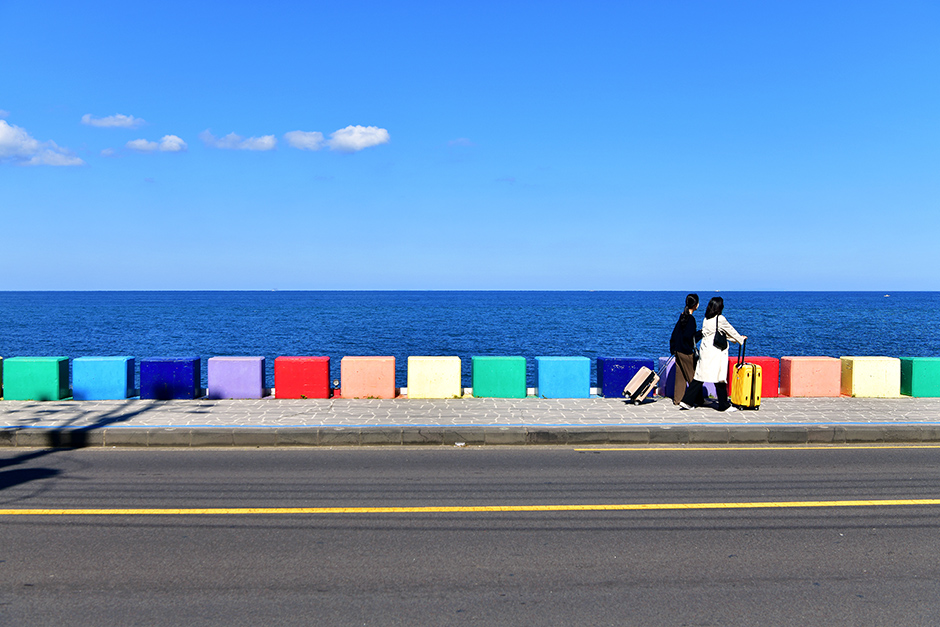
Dodu-dong Rainbow Coastal Road (도두동 무지개해안도로)
16.0Km 2023-02-15
1734, Dodu 1(il)-dong, Jeju-si, Jeju-do
+82-64-740-6000
Dodu-dong Rainbow Coastal Road is a unique road located 10 minutes away by car from the airport. Locals had been voicing their opinions on adding colors to the protective walls installed along the coastal road in order to prevent cars from veering off the road and as a result, the walls came to wear rainbow colors. The road became famous among tourists and became known as the Dodu-dong Rainbow Coastal Road. It is fun to check out the various sculptures in the area including that of a haenyeo (female divers). Nearby Dodubong Peak is within a walking distance, and leads to the Olle Trail course, one of the hidden gems of Jeju Island. The slope is gradual so it is not a difficult course.

Sun Okine Myungga (순옥이네명가)
16.3Km 2024-02-27
8 Dogong-ro, Jeju-si, Jeju-do
Sun Okine Myungga is a renowned jeonbong mulhoe (cold raw abalone soup) restaurant operated by haenyeo, female divers who free dive to gather seafood. They offer dishes prepared with freshly gathered natural seafood such as abalone, sea urchin, and small abalone. Popular menu items include seongge miyeokguk (sea urchin and seaweed soup) and haemul ttukbaegi (seafood hot pot). The rich flavor of abalone, combined with the refreshing taste of seafood, creates a deep and satisfying taste. Located near Jeju Airport, it's a popular dining spot frequented by tourists.
![Manjanggul Lava Tube [National Geopark] (만장굴 (제주도 국가지질공원))](http://tong.visitkorea.or.kr/cms/resource/55/3354155_image2_1.jpg)
Manjanggul Lava Tube [National Geopark] (만장굴 (제주도 국가지질공원))
16.3Km 2025-03-31
182 Manjanggul-gil, Jeju-si, Jeju-do
Manjanggul Lava Tube, located in Gimnyeong-ri, Jeju, is part of the Geomunoreum Lava Tube system. The lava tube stretches roughly 7,400 meters, with a maximum x_height of 25 meters and x_width of 18 meters. These measurements make it one of the largest lava tubes in the world. Manjanggul holds great value for science and conservation studies, having well-maintained formations despite being formed over one hundred thousand years ago.
The majority of the cave is closed off, with only 1 kilometer being open to tourists. Within this open section, visitors can see a variety of lava tube and cave topographical features, including stalagtites, stalagmites, and stone pillars. Among these, the 7.6-meter-tall stone pillar at the end of the open section is recorded as the largest in the world.
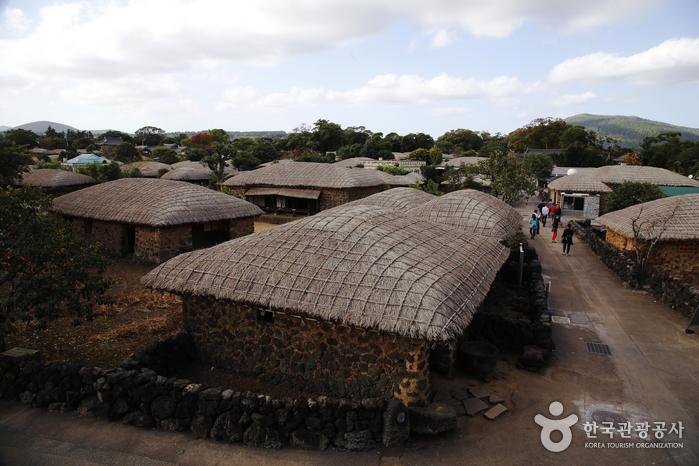
Seongeup Folk Village (성읍민속마을)
16.4Km 2024-03-11
3294, Seongeup-ri, Pyoseon-myeon, Seogwipo-si, Jeju-do
+82-64-710-6797
Seongeup Folk Village has been designated and protected as a folk village, preserving the characteristics of Jeju's old private houses. Various tangible cultural heritage and intangible cultural heritage such as folk songs and games, local foods and craftmanship, and Jeju dialect are being passed down. The village offers traditional culture and traditional house experiences, and holds cultural events every October and November.
Maze Museum (메이즈랜드)
16.5Km 2025-10-23
2134-47 Bijarim-ro, Gujwa-eup, Jeju-si, Jeju-do
+82-64-784-3838
Maze Museum, a comprehensive theme park, features the world's longest stone maze, spanning 5.3 km and themed around Jeju’s Samda—the island’s iconic triad of stones, wind, and women. Proudly showcasing Korea’s natural beauty, the park also houses a museum where visitors can explore the history of mazes, view artifacts, and solve puzzles dating from the 14th century to modern times. Constructed from local stones known for their high far-infrared ray emission and the western arborvitae trees, which release beneficial phytoncides, Maze Museum is an eco-friendly park designed with health benefits in mind, offering more than just walking mazes. The site is enveloped by a variety of 40-year-old trees, providing an ideal environment for forest bathing and immersing in nature.
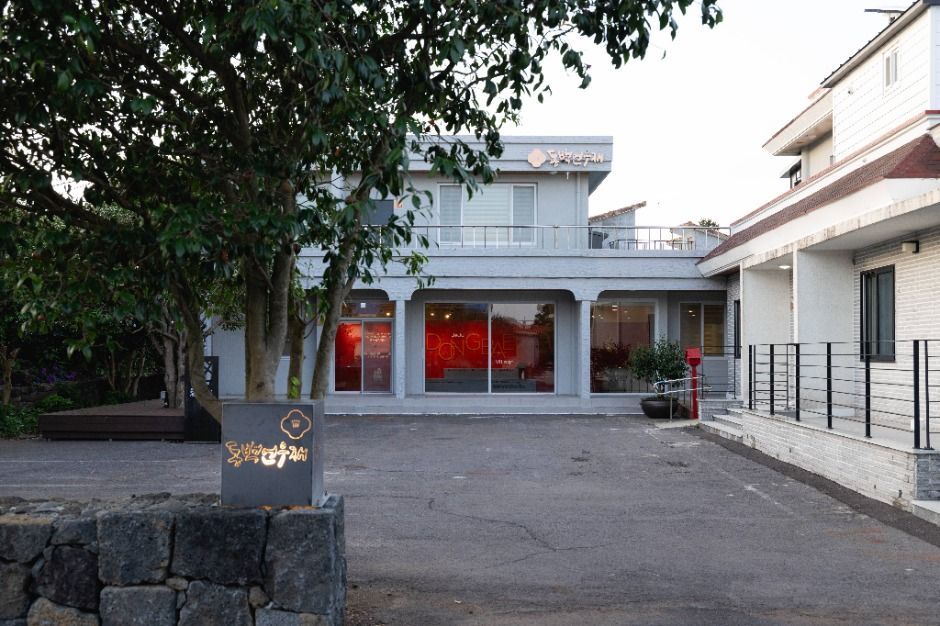
Jeju Dongbaek Village (제주 동백마을)
16.6Km 2025-11-21
22-1 Hansin-ro 531beon-gil, Namwon-eup, Seogwipo-si, Jeju-do
Located in Seogwipo, Jeju Camellia Village has a 300-year history with its native camellia trees, and is involved in various projects. Visitors can explore the 300-400-year-old camellia trees scattered throughout the village, purchase authentic camellia oil from the community-operated mill, and participate in various experience programs such as camellia soap-making and cooking classes using camellia oil. From October to March, visitors can also purchase tangerines, locally produced by the village residents. The local community is dedicated to preserving the camellia forest for future generations, offering visitors a chance to experience the village’s beauty.

Jeju Holic Museum (제주홀릭뮤지엄)
16.6Km 2024-07-24
2835 Pyeonghwa-ro, Aewol-eup, Jeju-si, Jeju-do
Jeju Holic Museum is located in what used to be a senior care facility that closed down. The museum tells the story of Jeju through five different spaces, using unique and modern ways of storytelling.
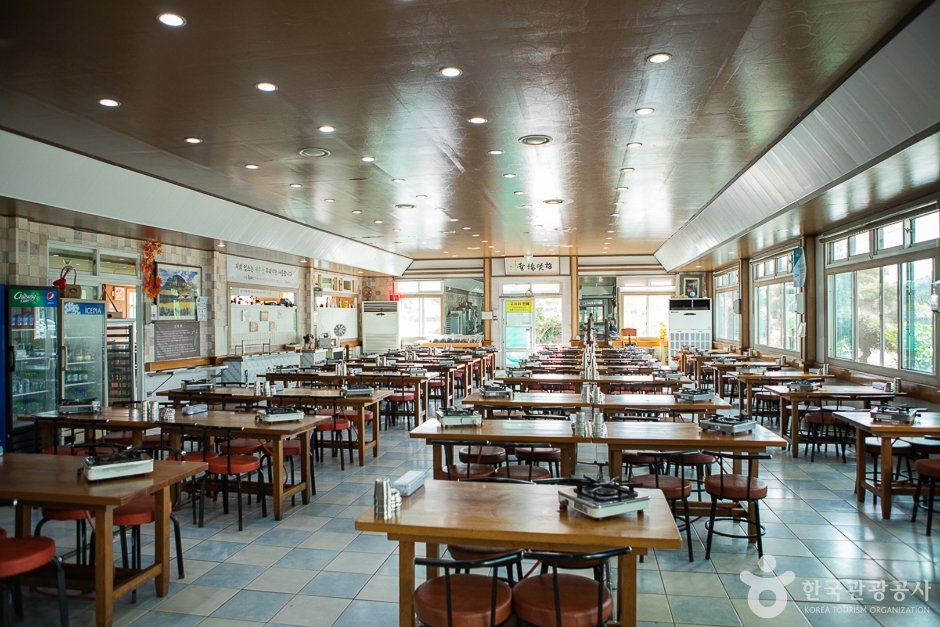
Wang Ilbeonji Sikdang (왕일번지식당)
16.7Km 2024-02-20
4610 Jungsangandong-ro, Pyoseon-myeon, Seogwipo-si, Jeju-do
Wang Ilbeonji Sikdang specializes in black pork bulgogi. Their dwaeji bulgogi (pork bulgogi) is marinated in a spicy sauce and served with Jeju bracken and shiitake mushrooms. Accompanied by seaweed soup and a variety of side dishes, the meal also features juicy and thick black pork belly. It offers a plentiful meal at a reasonable price and is only open for lunch.
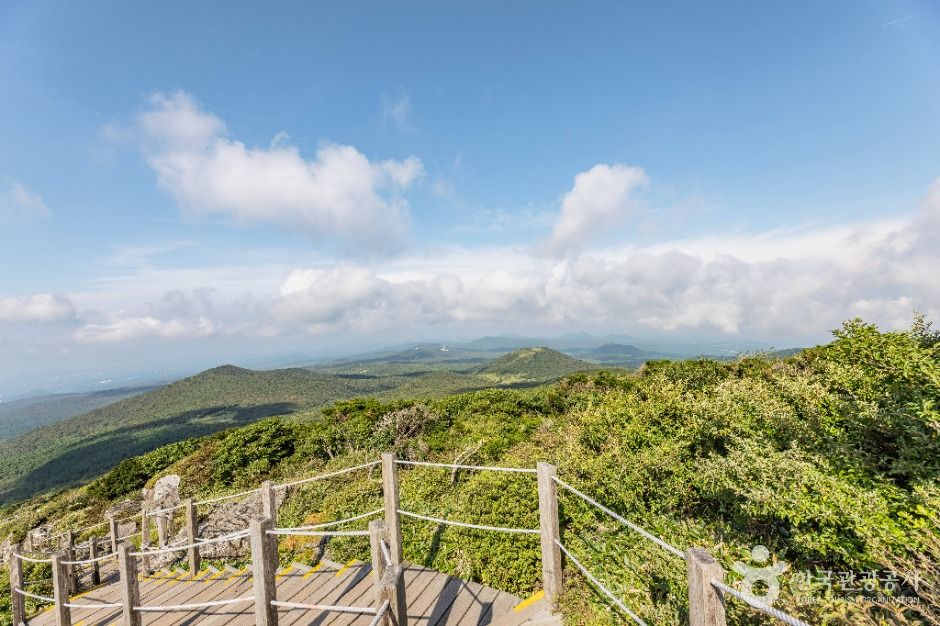
Yeongsil Trail (Hallasan National Park) (한라산 영실)
16.8Km 2025-10-31
246 Yeongsil-ro, Seogwipo-si, Jeju-do
+82-64-713-9950
Yeongsil Trail is renowned as the shortest yet the best trail for its beautiful scenery among those of Hallasan Mountain. It is 5.8 kilometers and takes approximately 2 hour and 30 minutes to get to the destination. Starting from Yeongsil Rest Area, an uphill path emerges along steep mountain ridges to reach the Nambyeok Watershed. With its steep and flat parts, the hike is easy enough for children. It's a wonderful way to appreciate the lush forest and beautiful scenery.
 English
 한국어
한국어 日本語
日本語 中文(简体)
 Deutsch
 Français
 Español
 Русский


