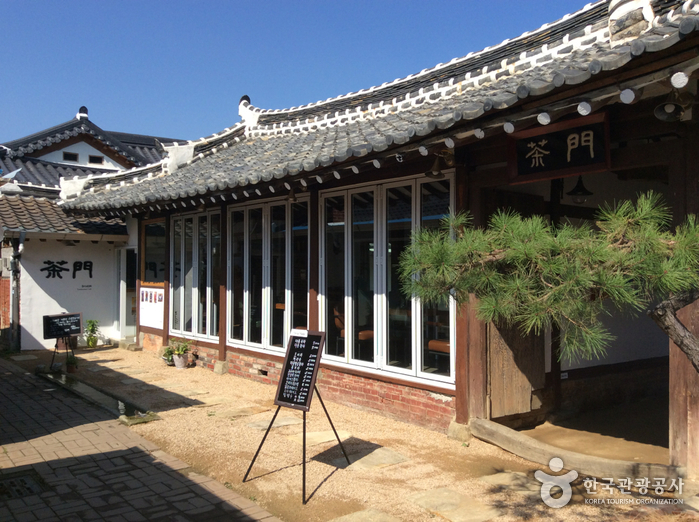
Damun (다문)
12.8Km 2024-04-07
74-8, Eunhaeng-ro, Wansan-gu, Jeonju-si, Région Jeonbuk
+82-63-288-8607
Situated in Jeonju Hanok Village, Gyo-dong, Jeonju-si, Damun serves Korean table d’hote in a restaurant divided into large and small rooms within a hanok building structure.
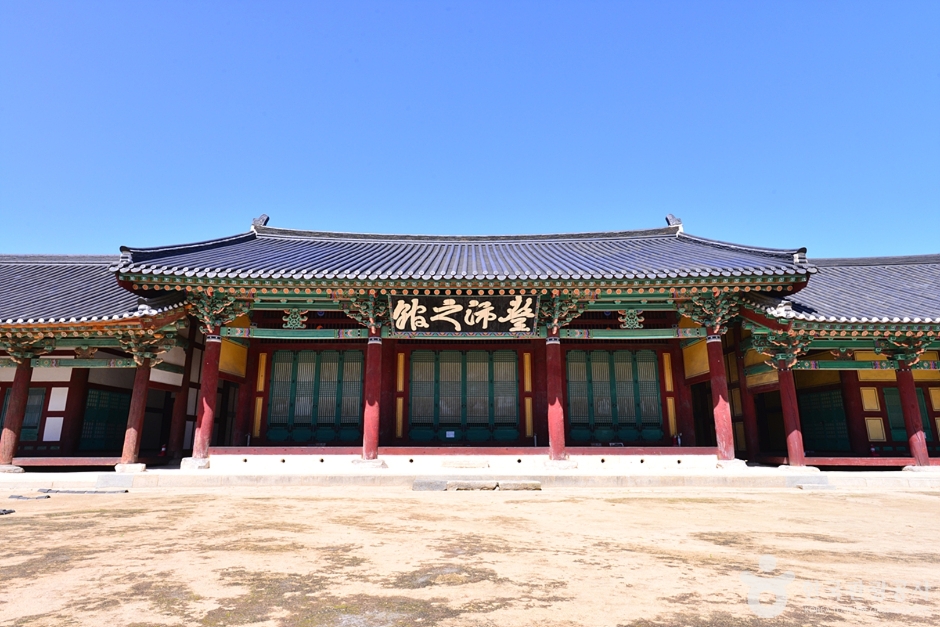
Jeonju Pungbaejigwan (전주 풍패지관 (전주객사))
12.8Km 2024-07-09
59, Chunggyeong-ro, Wansan-gu, Jeonju-si, Jeonbuk
Durant la période de la dynastie Joseon, les officiels du gouvernement ser servaient de cet endroit comme lieu de résidence lors de leur visite à Jeju. Le lieu est désormais accessible au public. Le long et spacieux 'maru' (place centrale en bois) est ouvert au public, faisant de l'endroit un endroit confortable pour se reposer. Situé dans le centre de Jeonju, le site est facile à trouver en étant proche du village des hanok de Jeonju.
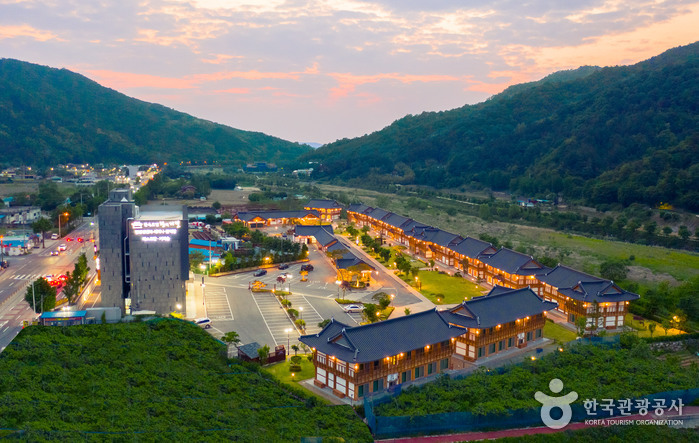
Sunjonggwan of the Royal Room / 왕의지밀 순종관
12.8Km 2025-08-13
5218-6, Chunhyang-ro, Wansan-gu, Jeonju-si, Région Jeonbuk
+82-63-284-1004
This hanok (traditional Korean house) hotel is located near Jeonju Hanok Village. The hotel complex stands on a plot of land spanning 19,840 m2, containing 11 residential buildings and other facilities. Modern hanok buildings are built on a line, blending with the surrounding nature to offer a comfortable stay. The name of the hotel is evident in the 11 residential buildings, all named after the kings of the Joseon Dynasty.
Sunjonggwan has six rooms in total. The rooms are divided into Gold and Silver Rooms, and are classified into Grade 2, Grade 3, and Grade 5 rooms, after the grading system used for government officials during the Joseon Period. Gold Rooms are located on the second floor, while the 1st floor is occupied by the Silver Rooms. Each room is furnished with a combination of hanok’s unique charms and modern comfort. Exposed wooden beams fill the room with a gentle scent of wood, while window walls offer an expansive view of the scenery outside.
Restaurants such as Samtaegeuk Restaurant, the site of the hotel’s breakfast offering, and Samjogo Restaurant, a Korean restaurant serving lunch and dinnertime, are designated as COVID-19 Safe Restaurants by the city of Jeonju. The Convention Center, which houses a hanok cafe, also offers a number of different facilities for the guests. It takes only 10 min by car to reach most tourist sites in Jeonju.
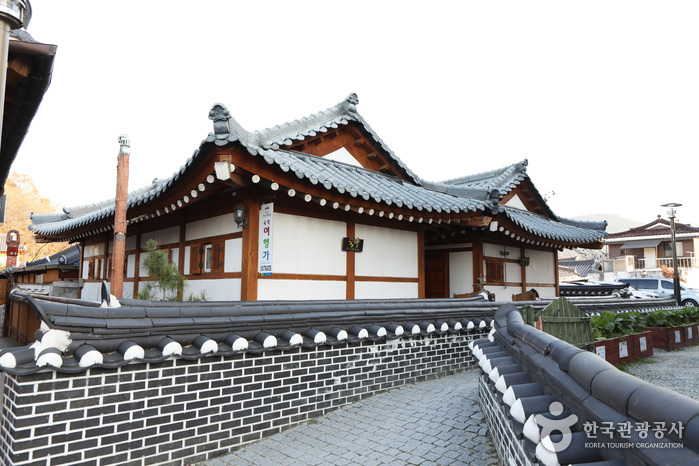
Yeohangga / 여행가
12.8Km 2025-08-12
74-11, Eunhaeng-ro, Wansan-gu, Jeonju-si, Région Jeonbuk
+82-63-231-3040, +82-10-7742-6738
Yeohangga is a guesthouse owned and run by a woman who majored in early childhood education and who has been teaching children for over 20 years. The name means "A home for a happy trip," she says. It’s a unique guesthouse since the owner offers various traditional educational games. The cozy and comfortable guesthouse is a traditional Korean house built in March 2013 at a site where an old house used to be. The main building and detached building are divided by the ridge of the roof with beautiful rafters. There is another meaning to the name of the guesthouse: "a house where the woman is happy." She named it as such for a good reason. She used to live in Seoul when her parents advised her to move to Jeonju and run a guesthouse, leaving her husband and child behind. At first, she considered accepting only female guests, but it wasn't an option since most of the people visiting Jeonju are couples and groups of friends. Instead, she made sure the guesthouse is safe for women while building the house. Many female tourists traveling alone find this a great feature of the guesthouse because they feel safer during their stay. For one, she installed three doors for the rooms (1 transparent door, 1 opaque glass door, and a traditional Korean door). Not only do the guests feel safer; the rooms are also well-insulated thanks to the triple doors. The floors and walls are covered with traditional Korean paper coated with soybean oil, which is very environment-friendly. In the four rooms named “Spring,” “Summer,” “Autumn,” and “Winter,” there are many toys and materials for traditional Korean cognition games, such as “Chilgyo Game,” “Gonu Game,” and “Mabangjin.” It’s very likely that even Koreans have never heard of these games. The owner of the guesthouse chose these games specifically because they are perfect for children to play in a traditional Korean house. She teaches her little guests how to play the games. “Chilgyo Game” involves making a shape with 7 to 20 pieces, whereas “Gonu Game” is similar to the game of Chinese chess. "Mabangjin" is a type of IQ game that involves laying down a total of nine different numbers in three rows and columns so that the sum of the three numbers is identical when added horizontally, vertically, or diagonally. Many guests find these games interesting, and the owner of the guesthouse finds joy in teaching these games to as many families as possible. She recently took over another traditional Korean guesthouse called "Samrakheon" near the Jeonju Oriental Medicine Center. It's a stand-alone guesthouse for groups and families, and she uses the place to teach traditional games to more people.

Veteran Kalguksu (베테랑칼국수)
12.8Km 2025-07-10
135, Gyeonggijeon-gil, Wansan-gu, Jeonju-si, Jeonbuk
Il s’agit d’un restaurant de nouilles traditionnelles aimé des habitants de Jeonju Hanok Village depuis plus de 40 ans, ouvert en 1977. L’établissement est réputé pour son bouillon épais et onctueux, mijoté longtemps, auquel sont ajoutés du perilla (sésame sauvage), de la viande et des œufs.
Les nouilles utilisées ne sont pas les larges nouilles ordinaires, mais des nouilles fines à la texture ferme et élastique. Le plat est garni de poudre de perilla, de piment et d’algues séchées, offrant un goût et une présentation constants au fil des années.
Outre les kalguksu (nouilles coupées au couteau), le restaurant propose des nouilles froides au soja (kongguksu) au goût riche et onctueux, ainsi que des mandu (raviolis) généreusement garnis, qui accompagnent parfaitement les nouilles. Avec chaque commande, du danmuji (radis mariné jaune) et du kimchi de radis en dés (kkakdugi) sont servis ; ce dernier est préparé maison avec des radis d’hiver de Jeju, ce qui lui confère un goût encore meilleur.
◎ Informations sur la Hallyu : ce restaurant est l’un des établissements fréquentés par les acteurs du drama Vingt-cinq, vingt et un. L’actrice principale, Kim Tae-ri, y est venue pour son petit-déjeuner lors du tournage de son vlog, attirant l’attention en dégustant son bol sans en laisser une seule nouille. Tout près se trouve aussi "2521 Guesthouse", la maison d’hôte ayant servi de résidence à Hee-do dans le drama, qui vaut une visite après le repas.
Hakindang / 학인당
12.9Km 2025-08-12
45, Hyanggyo-gil, Wansan-gu, Jeonju-si, Région Jeonbuk
+82-63-284-9929
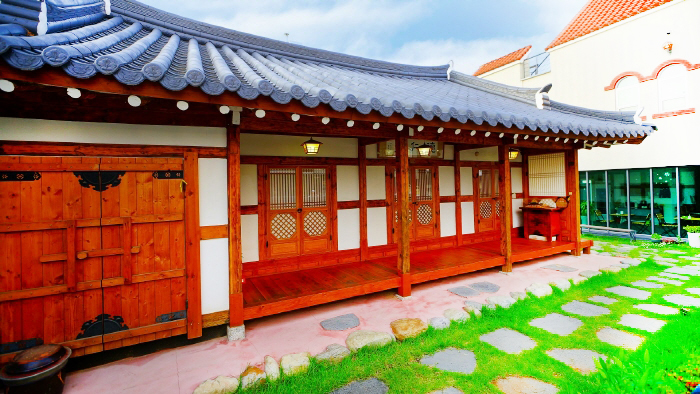
Hagindang was built by the same master builder and carpenter who took part in building the palaces. It's the oldest traditional Korean house in Jeonju Hanok Village and a city/province-designated Folklore Heritage No. 8 situated in Hyanggyo-gil. It has a tall gate in the middle of high walls on either side, behind which are a large front yard with a pond as well as trees surrounding the pond. The house behind this pond is in perfect harmony with the landscape. Right next to the tall gate are a detached building called “sarangchae” and an area designated for experiencing Korean tradition, including another detached building called “byeoldangchae” behind the main building named “Hagindang.” Bonchaedaegwan, which consists of three rooms named “Baekbeomjisil,” “Haegongjisil,” and “Injaejisil” exude elegance and grace The “sarangchae” is a stand-alone building with two rooms with an open living room called "daecheong" in between, making it a perfect place for an entire family to stay. The "byeoldangchae" has a total of three rooms, and the first one (Room No. 1) has a tea room with three windows made of thin wooden frames on three sides. Hagindang serves traditional Korean breakfast like the head family.
Deokindang
12.9Km 2024-04-07
28-3, Pungnammun 3-gil, Wansan-gu, Jeonju-si, Région Jeonbuk
063-282-6336, 010-5654-3554
Deokindang is located across from the west street of Jeonju Hanok Village. The guesthouse is surrounded by low walls, inside of which there are grass yard, stone pavement, and four traditional houses with three guestrooms, which are called the Large Room, Small Room, and Kitchen Room. Here, the "Kitchen Room” is not actually a kitchen, but a kitchen turned into a bedroom. The Large Room in the center of the main building can accommodate up to 8 people, making it a perfect place to stay for a large family. It’s furnished with thin, white calico sheets, which are very soft to the touch.
Situated on the outskirts of Jeonju Hanok Village and yet very close to Gyeonggijeon Shrine, Jeondong Catholic Cathedral, Nambu Market, and Jeonju Pungpae Jigwan (Jeongju Gaeksa. Treasure No. 583), the guesthouse is quiet and conveniently located as well for those taking a tour of Jeonju. The owner of Deokindang also owns another guesthouse called Su House, so the guests of Deokindang can have access to the Community Room of Su House.
Gaeksa-gil (객사길)
12.9Km 2024-04-08
10-1, Jungang-dong 2-ga, Wansan-gu, Jeonju-si, Région Jeonbuk
Les maisons Gaeksas, qui ont été installés dans chaque village pendant la période de Goryeo et de Joseon, étaient des logements destinés à accueillir des envoyés étrangers ou des fonctionnaires venus d'autres régions.
Dans le centre-ville de Jeonju, ce type de logement existe encore et la rue la plus animée du vieux centre-ville de Jeonju a été construite autour de cet espace. C'est la raison pour laquelle on appelle cette rue la rue « Gaeksa-gil ».
Gaeksa-gil, qui abonde en magasins et restaurants franchisés, est très prisé par les habitants de la localité et les touristes. Le Festival international du film de Jeonju près de la Gaeksa-gil constitue notamment un moment culturel important de la région. Ce festival, considéré comme l'un des trois meilleurs festivals de cinéma en Corée, est axé sur les films indépendants et a fait émerger de nombreux films remarqués et de nouveaux acteurs. Tout près de la Gaeksa-gil, se trouve également le Studio du film de Jeonju et plusieurs salles de cinéma, c'est pourquoi on l'appelle aussi cette rue la « rue du cinéma ». En vous rendant à Gaeknidan-gil, vous pourrez trouver des restaurants, des cafés et des magasins de vêtements ciblant les cinéphiles.
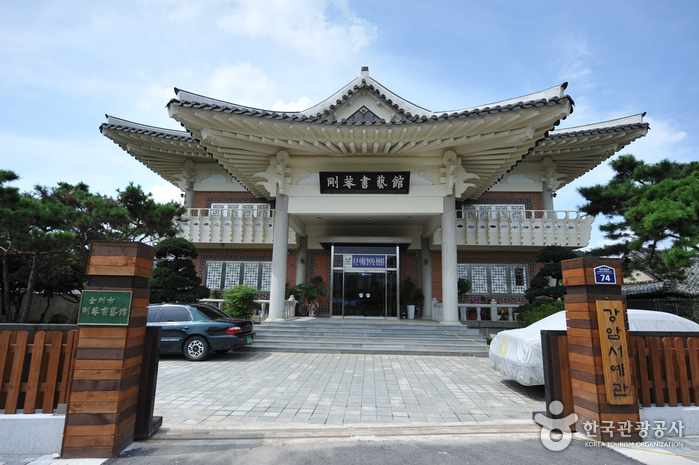
Musée de la calligraphie Gangam (강암서예관)
12.9Km 2024-04-07
74, Jeonjucheondong-ro, Wansan-gu, Jeonju-si, Région Jeonbuk
+82-63-285-7442
Inauguré en 1995, le musée Gang-am est un établissement spécialisé en calligraphie. Situé dans le village des hanok (maisons traditionnelles coréennes) de Jeonju, il expose environ mille œuvres de calligraphes illustres tel que Kim Jeong-Hui (1786-1856, peintre, calligraphe et savant), Lee Sam-Man (1770-1845, calligraphe), Kim Hong-Do (1745- ?, peintre), Jeong Yak-yong (1762-1836, savant), etc.. Le musée s’étend sur 872 ㎡, il comporte des salles d’expositions et des salles de conférences. Sa collection comprend 1.162 pièces.
Porte Pungnammun (전주 풍남문)
12.9Km 2024-04-08
1, Pungnammun3(sam)-gil, Wansan-gu, Jeonju-si, Région Jeonbuk
+82-63-287-6008
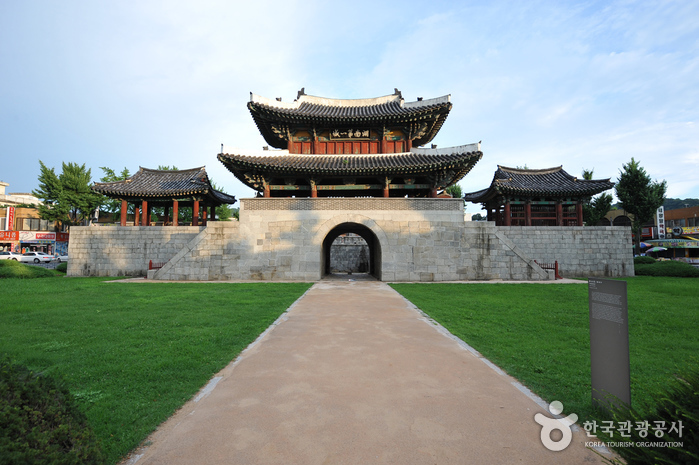
La porte Pungnammun a été construite dans le milieu du royaume de Jeoson (1768) et désignée trésor national no 308. Des 4 portes originales, c’est la seule qui reste (dans la partie sud de la ville). Sa structure a été partiellement détruite lors de l’invasion des forces étrangères de 1592 à 1598. Et a été reconstruite en 1978. Jungcheung et mullu sont au centre de la porte, épousant la forme de l’arche. Ces formes particulières forment le symbole du potentiel protecteur de la porte Pungnammun tout comme ils forment le symbole de sa grandeur.
 Français
 한국어
한국어 English
 日本語
日本語 中文(简体)
 Deutsch
 Español
 Русский


