Lotte Mart - Seosan Branch [Tax Refund Shop] (롯데마트 서산점 [사후면세점]) - Area information - Korea travel information

Lotte Mart - Seosan Branch [Tax Refund Shop] (롯데마트 서산점 [사후면세점])

Lotte Mart - Seosan Branch [Tax Refund Shop] (롯데마트 서산점 [사후면세점])

16.0Km    2024-04-22

6 lots, 27, Chungui-ro, Seosan-si, Chungcheongnam-do

-

Shinpyeong Brewery (신평양조장 백련 양조문화원)

Shinpyeong Brewery (신평양조장 백련 양조문화원)

16.3Km    2023-06-28

813 , Sinpyeong-ro, Dangjin-si, Chungcheongnam-do
+82-41-362-6080

A 100-year-old family business passed on for three generations, a brewery where time ripens. A special Korean brewery tour to experience the past, present, and future of the brewing industry
Shinpyeong Brewery is a modern cultural heritage restoration project by the Ministry of Agriculture, Food, and Rural Affairs. It's a traditional brewing artistic enterprise that inherits and develops the modern and contemporary brewing culture of Korea by brewing and manufacturing alcoholic beverages with the craftsmanship of old sake masters. At Shinpyeong Brewery, a famous traditional liquor brewery that has been brewing sake for three generations in the same place for a long time with the excellent rice of Shinpyeong, beautiful liquor containing the scent of life is ripening today.

Deoksungsan Mountain (덕숭산)

Deoksungsan Mountain (덕숭산)

16.5Km    2021-06-30

Deoksan-myeon, Yesan-gun, Chungcheongnam-do
+82-41-339-8930

Deoksungsan Mountain is referred to as Chungcheong region's Geumgangsan Mountain for its beauty. Within Deoksungsan Mountain is Sudeoksa Temple, famous for its Daeungjeon Hall as the oldest surviving wooden building in Korea. The mountain's most prominent features are the oddly shaped rocks that are often compared to the shape of a human skull or a beast with its mouth wide open. Some of the most scenic points are Wonhyobong Peak, Seongmunbong Peak, and Haetaebawi Rock. Several Buddhist temples and cultural heritages occupy the mountain. The mountain is also a popular destination for family trips thanks to its short hiking course and Deoksan Hot Springs.

Sudeoksa Temple (수덕사)

Sudeoksa Temple (수덕사)

17.1Km    2021-12-03

79, Sudeoksaan-gil, Yesan-gun, Chungcheongnam-do
+82-41-330-7700

Sudeoksa Temple, which has played an important role in the history of Korea’s Buddhism, is located at the foot of Deoksungsan Mountain. It was one of twelve temples from the Baekje Kingdom mentioned in Chinese historical records. There is no historical record of when the temple was founded but researchers believe it was founded sometime during the reign of King Wuideok (554-597).

The main building of Sudeoksa Temple, Daeungjeon Hall, was constructed in 1308 during the Goryeo dynasty. It was repaired four times between 1528 and 1803, but fortunately kept its original beauty. In addition to Daeungjeon Hall, Sudeoksa Temple houses many cultural treasures, such as the Three-story Stone Pagoda of Sudeoksa Temple.

House and Tomb of Kim Jeong-hui (추사김정희선생고택·묘)

18.3Km    2024-02-21

261, Chusagotaek-ro, Sinam-myeon, Yesan-gun, Chungcheongnam-do

This house and tomb are where Kim Jeong-hui (pen name: Chusa, 1786-1856), a Joseon-era scholar and artist, lived and was laid to rest. Chusa Memorial Hall and Chusa Experience Center are found next to the house. After studying in Qing China, Kim Jeong-hui served in multiple government posts. He is best known for his unique calligraphical style, which bears his courtesy name (Chusa), and many works of art that survive to this day. The Experience Center offers traditional art experiences inspired by Kim Jeong-hui’s works.

House of Chusa (추사고택)

House of Chusa (추사고택)

18.4Km    2022-12-28

261, Chusagotaek-ro, Yesan-gun, Chungcheongnam-do
+82-41-339-8248

House of Chusa, Chusa Gotaek in Korean, is the traditional Korean house of the renowned scholar and calligrapher Chusa, also known as Kim Jeong-hui. This old house is known to have been constructed by the great-grandfather of Chusa, Kim Han-Sin.

The Korean-style house compound (266.11 m²) consists of munganchae (a guesthouse), soseuldaemun (a high gate), sarangchae (ㄱ-shaped men's quarters), anchae (ㅁ-shaped women’s quarters) and a shrine where the remains of Chusa are enshrined. Theㄱ-shaped Sarangchae stretches for one kan (traditional measuring unit) to the south and 2 kans to the east and is comprised of two rooms and a daecheongmaru (living area). The Anchae consists of a six-kan daecheongmaru and two one-kan rooms.

Located on the ground is a tomb where Chusa’s great-grandfather (Kim Han-Sin) and his wife (Hwasun Princess) are buried. Nearby, visitors will see a gate that was constructed to commemorate Princess Hwasun’s faithfulness to her husband.

Located approximately 600 meters to the north of the old house is a lacebark pine tree, which was designated as a Natural Monument. The lacebark pine tree, originally from northern China, is among the few of its kind in Korea. It is said that Chusa snuck the pine across the border from China (formerly, the Qing dynasty) into the country when he was 25 years old and planted it at the tomb of his great-grandfather. Originally, the tree had three branches, but two were broken and the third branch was damaged. In 1980, the damaged branch was treated and since then, the tree has been kept under strong protection.

Chusa Memorial Hall (추사기념관)

Chusa Memorial Hall (추사기념관)

18.5Km    2024-12-27


+82-41-339-8247

Chusa Memorial Hall opened in 2008, holds works of Chusa Gim Jeong-hui including his arts, epigraphy, calligraphy and more. The memorial hall preserves and exhibits Chusa Gin Jeong-hui's works to show future generations about his achievements. 

Yesan Hwaamsa Temple (화암사 (예산)

Yesan Hwaamsa Temple (화암사 (예산)

18.9Km    2025-08-18

21-29, Yonggung 1-gil, Yesan-gun, Chungcheongnam-do
+82-41-332-9250

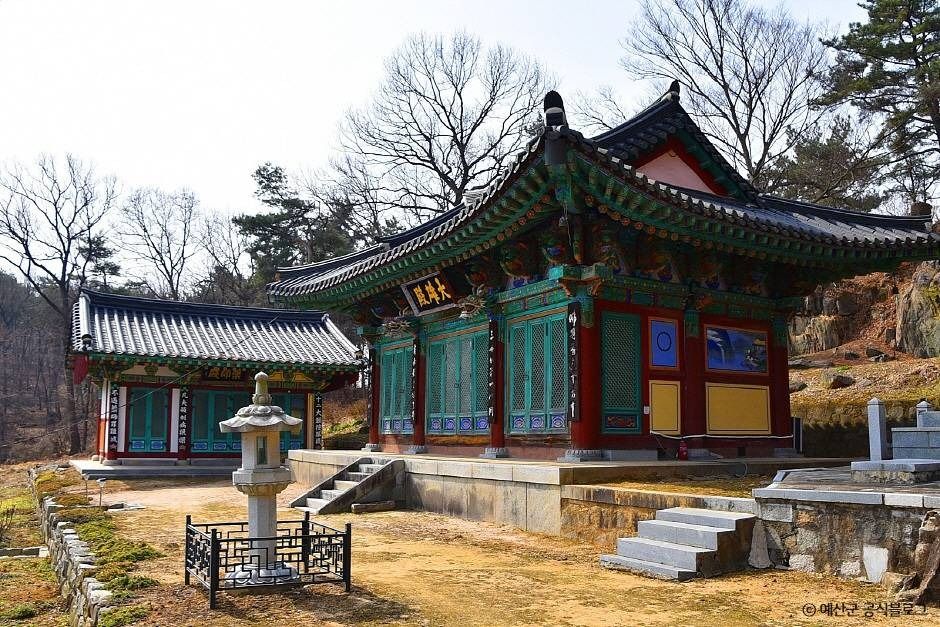
Hwaamsa Temple is located near Joseon dynasty's scholar and writer Kim Jeong-hui's, also referred to his pen name Chusa, house. The temple has ties with the ancient writer, as the temple is known to have been repaired and renovated by Kim Jeong-hui's great grandfather. There are no records that explains the foundation of Hwaamsa Temple, and only a timeline of its reconstruction can be found in "Records of Hwaamsa Temple Restoration" plaque, which is displayed in Sudeoksa Temple Museum. The timeline was recorded by Kim Myeong-hee in 1848, and written by Kim Seong-hee, and carved by Cho Seok-shin. The name "Hwaamsa" was given by King Yeongjo (r. 1724-1776).