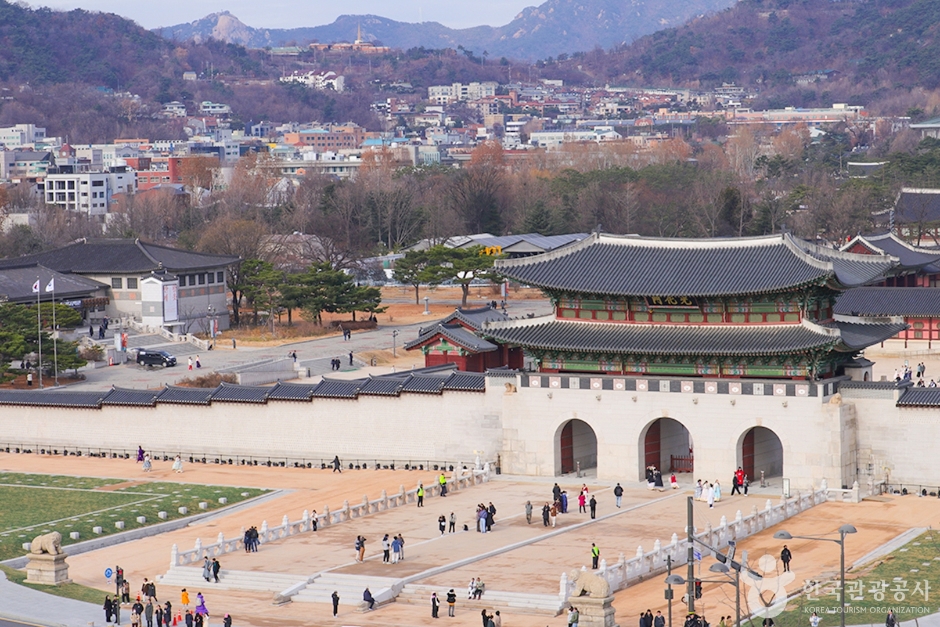
Gwanghwamun Gate (광화문)
15.5Km 2024-12-04
161 Sajik-ro, Jongno-gu, Seoul
+82-2-3700-3900
Built in 1395 under the reign of King Taejo, the first king of the Joseon dynasty, Gwanghwamun Gate is the southern gate of Gyeongbokgung Palace. It is also the main gate of the palace, therefore larger and fancier in comparison to the other gates. Gwanghwamun Gate consists of three arched gates; the center gate was used by the king, while the other two were used by the crown prince and royal officials. The tall granite walls of the gate serve as a platform for the wooden gate tower that watches over the city. The gate has a sign with its name written at the top center of the gate tower.
Gwanghwamun Gate went through several damages and restorations over the course of history. It was first severely damaged during the Imjin War (1592-1598) and was not restored until the reconstruction of Gyeongbokgung Palace in 1864. Under the Japanese administration, the gate was demolished and relocated to the north of the palace's eastern gate, followed by series of damages during the Korean War (1950-1953). In 1968, Gwanghwamun Gate was relocated back to the south of the palace and was rebuilt using concrete; however, the gate’s position was shifted a few meters away from its original location. In 2006, a major reconstruction project took place to restore Gwanghwamun Gate to its original state and location, disassembling the structure completely and replacing concrete with granite and wood. After three years and eight months of construction, Gwanghwamun Gate was fully restored to its original form and was open to the public on August 15, 2010.
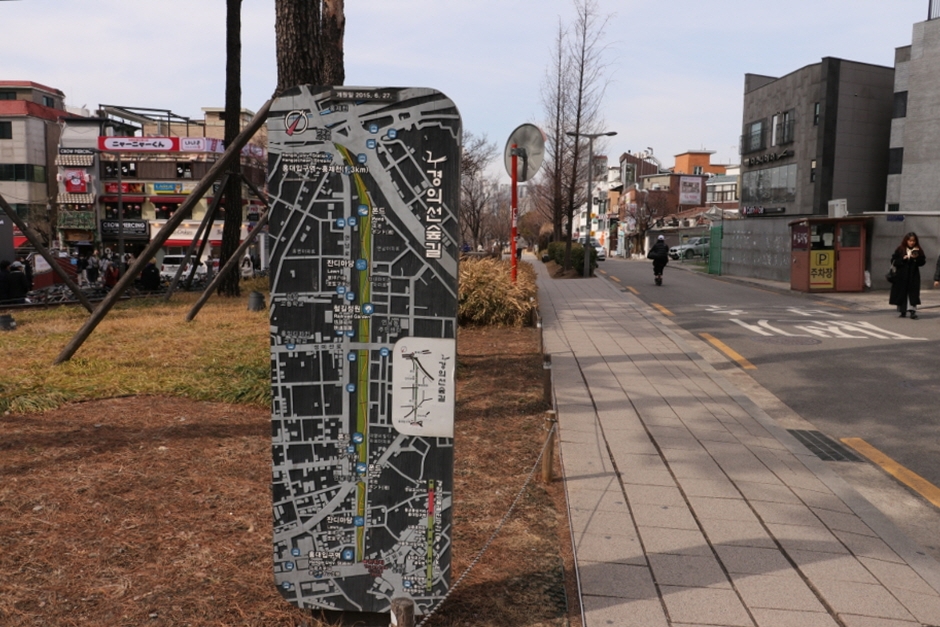
Yeonnam-dong (연남동)
15.5Km 2024-03-19
Yeonnam-dong, Mapo-gu, Seoul
Yeonnam-dong, located near Hongik University Station, has become a hot spot in Seoul as young artists and hipsters gather. It is densely packed with art spaces, and every alley is filled with unique concept cafés and many restaurants. There are also many guesthouses, editorial shops, and fashion stores, along with Yeontral Park, which was transformed from the old Gyeongui Line railroad into a park.
![Seoul Crown 88 Guest House [Korea Quality] / 서울크라운88 게스트하우스 [한국관광 품질인증]](http://tong.visitkorea.or.kr/cms/resource/46/2652746_image2_1.jpg)
Seoul Crown 88 Guest House [Korea Quality] / 서울크라운88 게스트하우스 [한국관광 품질인증]
15.5Km 2025-10-23
189 , Seongmisan-ro, Mapo-gu, Seoul
+82-2-720-2960
Seoul Crown 88 is a foreigner-only guesthouse located in Yeonnam-dong, Mapu-gu, Seoul. Accomodation is in dormitories for up to four people, which are equipped with personal lockers and toilets. The simple kitchen and living room are shared. The guesthouse is close to Hongik University Station, giving easy access to Incheon Airport or the Gangnam area, and there are many cafes and famous restaurants nearby: an alley traveller’s paradise! A simple free breakfast is provided, as is information in English and Chinese.
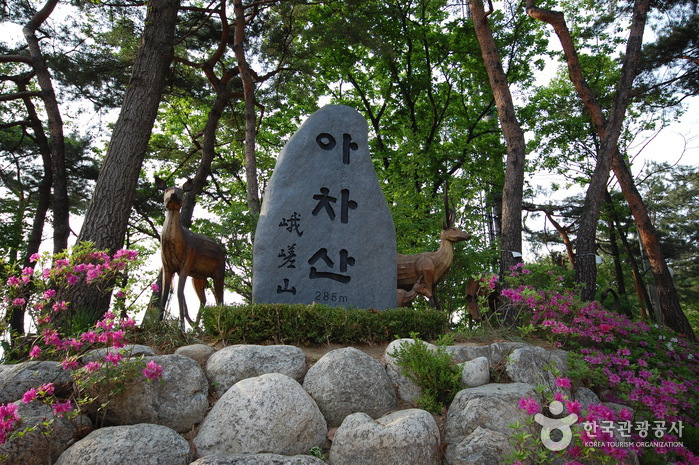
Achasanseong Fortress (아차산성)
15.5Km 2023-04-05
Gwangjang-dong, Gwangjin-gu, Seoul-si
+82-2-450-7593
Achasanseongseong Fortress boasts magnificent views of the Hangang River and skyline. The 200m-high mountain fortress wall was built to face southeast, towards the Hangang River. It is also called Janghan-seong or Gwangjang-seong. A fierce battle was once fought here among Gogury, Baekje and Silla because of its strategic location during the period of the Three Kingdoms. King Gae-Ro of Baekje (r. 455-475) died in the war by the Goguryeo forces sent by King Jang-Su (r. 413-491) and General Ondal of Goguryeo was also killed in a battle with the Silla army in 590.
Achasan Mountain is popular as a citizens’ resting place with a historical trail and a natural park including various facilities such as walkway, mountain walkway, a badminton court, a wrestling range, an archery range, various amusement facilities for children, benches, and pavilion.
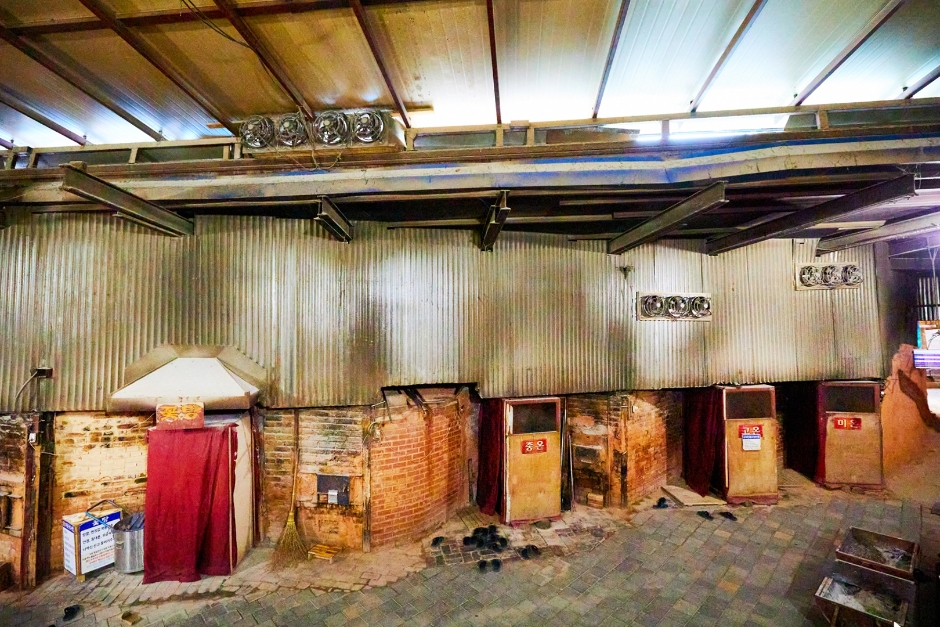
Supsok Hanbang Land (숲속한방랜드)
15.6Km 2024-03-18
75-7 Bongwonsa-gil, Seodaemun-gu, Seoul
Jjimjjilbang, a Korean-style sauna that combines a traditional bathhouse with a hot steam room, is often ranked high among the unique experiences in Korea chosen by foreigners. Taking a steam bath in a charcoal kiln discharges waste products from the skin through sweat and eliminates accumulated fatigue. Supsok Hanbang Land has several charcoal kilns for different temperatures. Using them in order from low to high-temperature rooms is good, but the highest-temperature room, “Kkottang,” has a risk of causing skinburn, so visitors are advised to wear socks and cotton gloves to enter the room. Another unique experience is to grill sweet potatoes or rice cakes on the brazier in front of the charcoal kiln.
Songhyeon Green Plaza (열린송현 녹지광장)
15.6Km 2025-11-11
Songhyeon-dong, Jongno-gu, Seoul
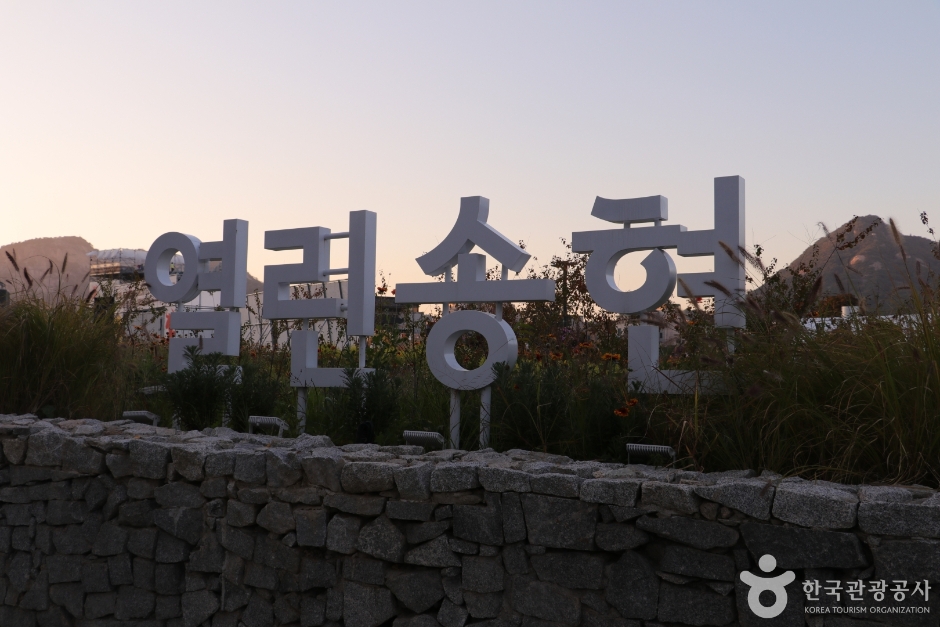
Songhyeon Green Plaza, located between Gyeongbokgung Palace and Jongno, is a space for culture and rest. The site was formerly used as housing for Shiksan Bank during Japanese rule. After Korea’s liberation, it served as a residence for the US Embassy and military personnel. Later in 1997, it was returned to the Korean government but remained unused for years. In 2022, the ownership was transferred to the Korean House and Land Corporation and then to the Seoul Metropolitan Government, which redeveloped it into a green plaza and opened it to the public. Upon entering the plaza, visitors are greeted by a spacious lawn adorned with flowers during the blooming season. The plaza is connected to the nearby tourist attractions through shortcuts cutting through it, including Cheong Wa Dae (Blue House), Gwanghwamun Plaza, Insa-dong, and Bukchon Hanok Village.
Nakseonjae Hall (낙선재)
15.6Km 2021-09-30
99, Yulgok-ro, Jongno-gu, Seoul
+82-2-2148-1822
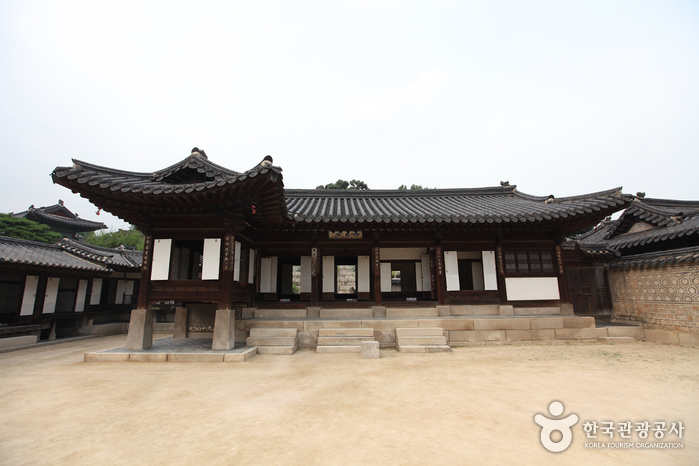
Located inside Changdeokgung Palace, Nakseonjae Hall is a one-story structure built in ikgong style (bird wing-shaped eaves placed on top of the pillars) with a hip tiled and gable roof. It has 6 kan in the front and 2 kan (traditional unit of measurement of the space between pillars) to the sides. It originally belonged to the nearby Changgyeonggung Palace, but came to be considered a part of Changdeokgung Palace in more recent years.
The hall was constructed in 1846 (12th year of King Heonjong’s reign) and it is collectively called Nakseonjae together with the adjacent Seokbokheon Hall and Sugangjae Hall.
Behind the building is a flower garden made of stacked large stones. The chimney, the flowers, and the oddly shaped stones harmoniously blend into one another to create an outstanding landscape gardening.
Seoul Sajik Park (사직공원(서울))
15.6Km 2021-11-12
89, Sajik-ro, Jongno-gu, Seoul
+82-2-2148-4149
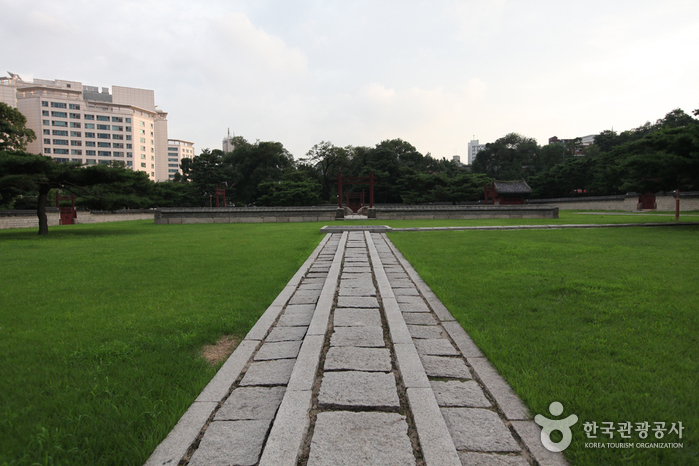
Sajik Park is one of the three most popular parks in Jongno-gu along with Tapgol Park and Samcheong Park. Located west of the Government Complex-Seoul on the southeastern foothills of Inwangsan Mountain, the park measures an impressive 188,710 m².
The name of the park dates back to 1395 when Taejo Yi Sung-gye made Sajik Altar (altar to the State deities) at the center of the park. "Sa" refers to the deity of the earth while "jik" refers to the deity of the five grains. Rites wishing for a good harvest were held regularly at Sajik Altar.
In the park are several playgrounds, statues of Sin Saimdang, Hwanghakjeong, and Yulkog Yi I, and the Municipal Children's Library. Dangun Shrine and Jongno Library are situated nearby. By following the path next to Sajik Park for approximately 5 minutes, travelers can reach the Inwangsan hiking path with relative ease.

Lee Ri-Ja Hanbok Museum (이리자 한복전시관)
15.6Km 2022-08-08
20, Samcheong-ro, Jongno-gu, Seoul
+82-2-734-9477
The Lee Ri-Ja Hanbok Museum displays the traditional clothing worn in Korea from birth to death. All hanbok displayed at the museum are created by the hanbok designer Lee Ri-Ja herself, who has over 40 years of experience.
 English
 한국어
한국어 日本語
日本語 中文(简体)
 Deutsch
 Français
 Español
 Русский


