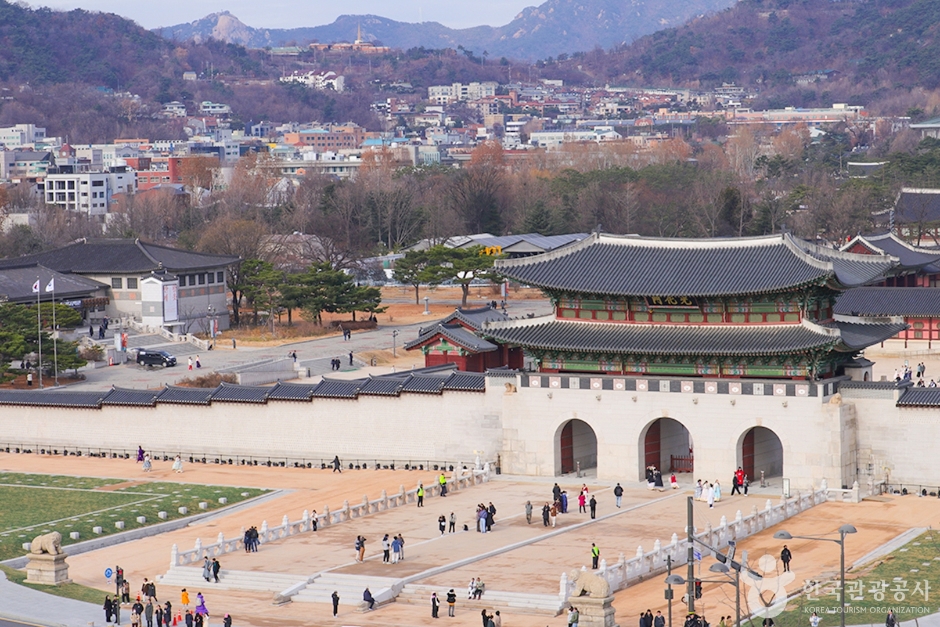
Gwanghwamun Gate (광화문)
826.3M 2024-12-04
161 Sajik-ro, Jongno-gu, Seoul
+82-2-3700-3900
Built in 1395 under the reign of King Taejo, the first king of the Joseon dynasty, Gwanghwamun Gate is the southern gate of Gyeongbokgung Palace. It is also the main gate of the palace, therefore larger and fancier in comparison to the other gates. Gwanghwamun Gate consists of three arched gates; the center gate was used by the king, while the other two were used by the crown prince and royal officials. The tall granite walls of the gate serve as a platform for the wooden gate tower that watches over the city. The gate has a sign with its name written at the top center of the gate tower.
Gwanghwamun Gate went through several damages and restorations over the course of history. It was first severely damaged during the Imjin War (1592-1598) and was not restored until the reconstruction of Gyeongbokgung Palace in 1864. Under the Japanese administration, the gate was demolished and relocated to the north of the palace's eastern gate, followed by series of damages during the Korean War (1950-1953). In 1968, Gwanghwamun Gate was relocated back to the south of the palace and was rebuilt using concrete; however, the gate’s position was shifted a few meters away from its original location. In 2006, a major reconstruction project took place to restore Gwanghwamun Gate to its original state and location, disassembling the structure completely and replacing concrete with granite and wood. After three years and eight months of construction, Gwanghwamun Gate was fully restored to its original form and was open to the public on August 15, 2010.
![Frisbee - Gwanghwamun Branch [Tax Refund Shop] (FR광화문점(금강 프리스비))](http://tong.visitkorea.or.kr/cms/resource/73/2878573_image2_1.jpg)
Frisbee - Gwanghwamun Branch [Tax Refund Shop] (FR광화문점(금강 프리스비))
830.7M 2024-04-16
1F, 8, Cheonggyecheon-ro, Jung-gu, Seoul
-
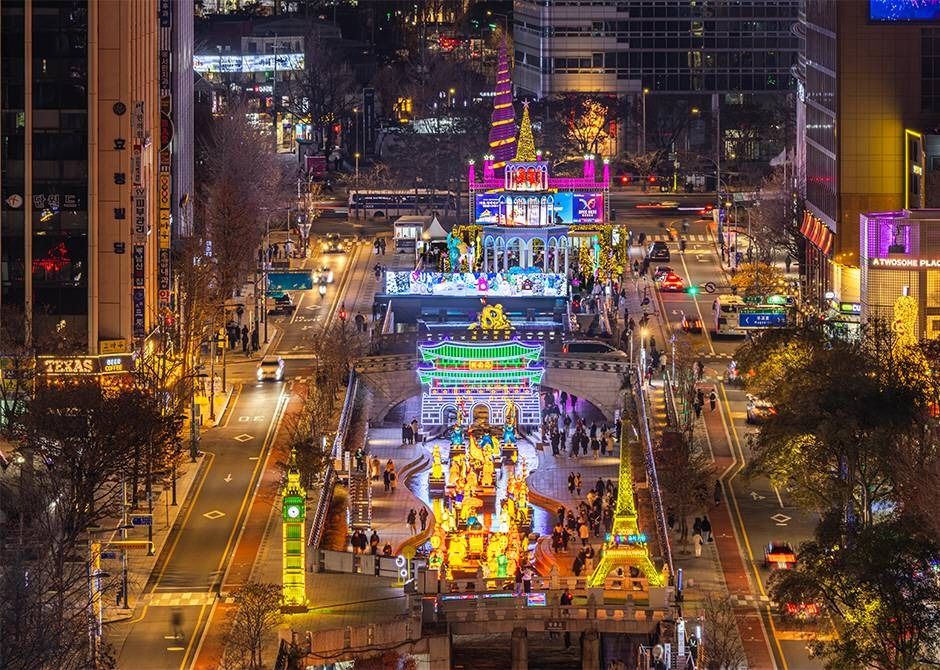
Seoul Lantern Festival (서울빛초롱축제)
836.3M 2025-11-13
Seorin-dong, Jongno-gu, Seoul
+82-2-3788-8168
The Seoul Lantern Festival is held every year and is one of the most anticipated festivals in Seoul. With various themed lanterns around Cheonggyecheon Stream, visitors can enjoy both traditional lanterns and modern LED lanterns. The festival provides much to see and do with the addition of Gwanghwamun Square Market.
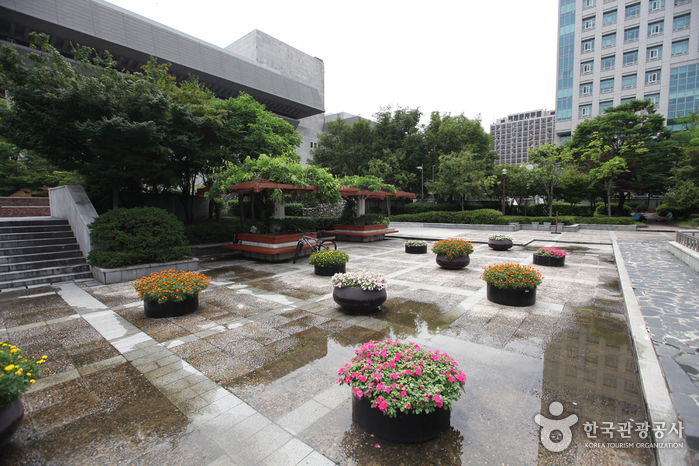
Sejong-ro Park (세종로공원)
842.3M 2022-08-31
jiha 189, Sejong-daero, Jongno-gu, Seoul
+82-2-722-9598
Sejong-ro Park is located next to Sejong Center for the Performing Arts in central Seoul. Inside the park, there are wooden benches and shaded areas where people can sit and relax. Also available are water fountains, a round outdoor stage, and various sculptures. The lunch crowd from the nearby office buildings often come to the park during weekdays. On the weekends, the park is also used as a venue for outdoor weddings.
Seoul's anthem and the poem "Bulnori" by Ju Yo-han are written on a memorial stone that can be found inside the park.
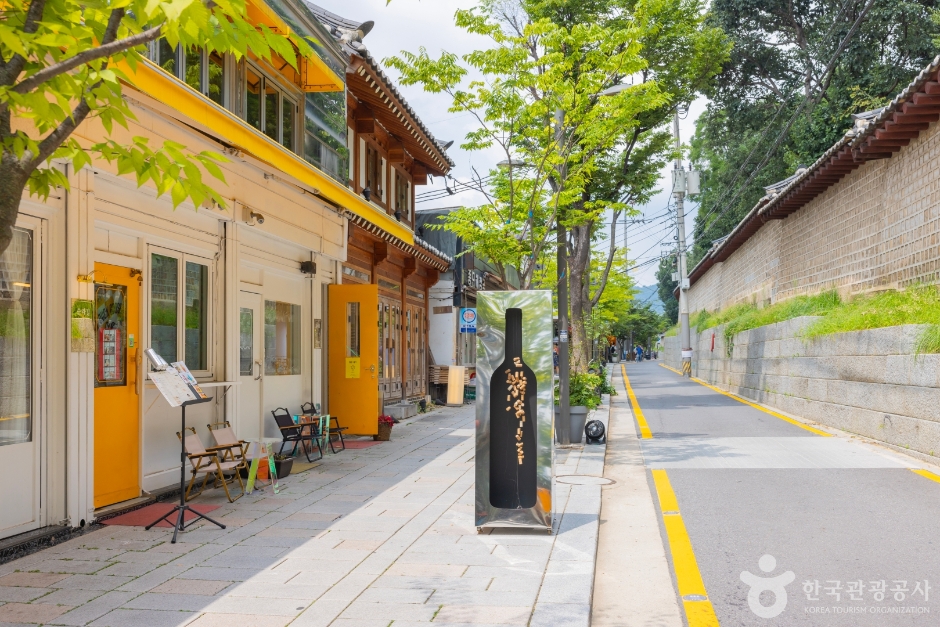
Seosulla-gil Road (서순라길)
845.2M 2024-10-14
150-3 Jong-ro, Jongno-gu, Seoul
Seosulla-gil Road is a road that was used by the nightguards during the Joseon dynasty. The road is on the west of Jongmyo Shrine with various attractions nearby including Ikseon-dong, Insa-dong, Bukchon, and Samcheong-dong, as well as restaurants, cafes, and handicraft workshops. The road is also a beautiful date course with flowers in spring and fall foliage in autumn..

Hwangsaengga Kalguksu (황생가칼국수)
847.8M 2024-03-18
78 Bukchon-ro 5-gil, Jongno-gu, Seoul
+82-2-739-6334
Hwangsaengga Kalguksu is a specialty restaurant located near Gyeongbokgung Palace, known for its kalguksu (noodle soup). Kalguksu is a type of noodle soup made by thinly slicing dough into noodles with a knife and boiling them in a broth made from beef bones, clams, or seafood. Their menu includes options like wang mandu (jumbo mandu), hanu suyuk (boiled Korean beef slices), kongguksu (noodles in cold soybean soup), beoseot jeongol (mushroom hot pot), and mandutguk (mandu soup). It was selected as a Michelin Guide Seoul 2023 restaurant.
![Coco Pharmacy [Tax Refund Shop] (코코약국)](http://tong.visitkorea.or.kr/cms/resource/91/2878591_image2_1.jpg)
![Seoul Papyrus [Tax Refund Shop] (서울파피루스)](http://tong.visitkorea.or.kr/cms/resource/74/2878574_image2_1.jpg)
![CheongKwanJang - Euljiro Branch [Tax Refund Shop] (정관장 을지로)](http://tong.visitkorea.or.kr/cms/resource/59/2878659_image2_1.jpg)
CheongKwanJang - Euljiro Branch [Tax Refund Shop] (정관장 을지로)
854.3M 2024-04-18
1F, 103, Eulji-ro, Jung-gu, Seoul
-
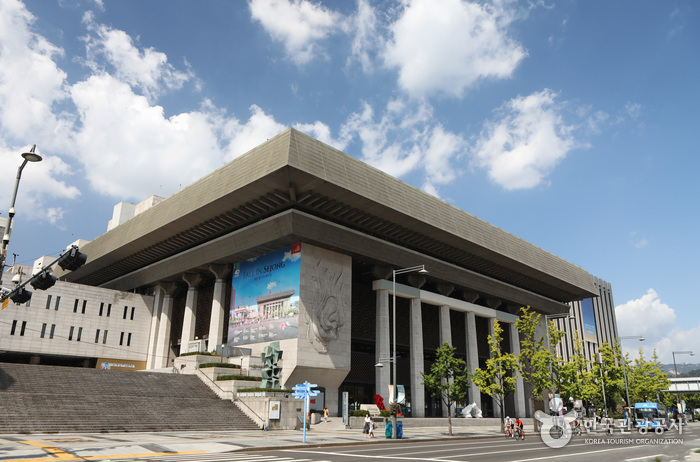
Sejong Center (세종문화회관)
860.0M 2023-06-14
175, Sejong-daero, Jongno-gu, Seoul
+82-2-399-1000
Sejong Center, officially known as Sejong Center for the Performing Arts, opened on July 1, 1999 to provide citizens with a cultural art space. Having completed a grand remodeling project in 2007, Sejong Center offers customer-friendly programs aimed at improving the quality of art performances in a comfortable resting area. Comprising the Grand Theater of Sejong Center, Sejong M Theater, Sejong Chamber Hall, Exhibition Hall, and other subsidiary facilities, Sejong Center is a multicultural art center.
Various genres of performances including traditional, classic, and crossover have taken place in the center, giving many opportunities for cultural nostalgia.
* Opened April 14, 1978
 English
 한국어
한국어 日本語
日本語 中文(简体)
 Deutsch
 Français
 Español
 Русский


