![Piaget - Lotte Avenuel Branch [Tax Refund Shop] (피아제 롯데 에비뉴엘점)](http://tong.visitkorea.or.kr/cms/resource/72/2889872_image2_1.jpg)
Piaget - Lotte Avenuel Branch [Tax Refund Shop] (피아제 롯데 에비뉴엘점)
1.5Km 2024-04-18
73, Namdaemun-ro, Jung-gu, Seoul
-
![IWC - Lotte Avenuel Branch [Tax Refund Shop] (아이더블유씨 롯데에비뉴엘점)](http://tong.visitkorea.or.kr/cms/resource/31/2889931_image2_1.jpg)
IWC - Lotte Avenuel Branch [Tax Refund Shop] (아이더블유씨 롯데에비뉴엘점)
1.5Km 2024-04-18
2F, 73, Namdaemun-ro, Jung-gu, Seoul
-
![Vacheron Constantin - Lotte Avenuel Branch [Tax Refund Shop] (바쉐론콘스탄틴 롯데 에비뉴엘점)](http://tong.visitkorea.or.kr/cms/resource/01/2890101_image2_1.jpg)
Vacheron Constantin - Lotte Avenuel Branch [Tax Refund Shop] (바쉐론콘스탄틴 롯데 에비뉴엘점)
1.5Km 2024-04-23
73, Namdaemun-ro, Jung-gu, Seoul
-
![Chopard - Lotte Avenuel Branch [Tax Refund Shop] (쇼파드 롯데 에비뉴엘)](http://tong.visitkorea.or.kr/cms/resource/10/2890310_image2_1.jpg)
Chopard - Lotte Avenuel Branch [Tax Refund Shop] (쇼파드 롯데 에비뉴엘)
1.5Km 2024-04-18
2F, 73, Namdaemun-ro, Jung-gu, Seoul
-
![Panerai - Lotte Avenuel Branch [Tax Refund Shop] (파네라이 롯데 에비뉴엘점)](http://tong.visitkorea.or.kr/cms/resource/42/2890442_image2_1.jpg)
Panerai - Lotte Avenuel Branch [Tax Refund Shop] (파네라이 롯데 에비뉴엘점)
1.5Km 2024-04-18
2F, 73, Namdaemun-ro, Jung-gu, Seoul
-
![Chaumet - Lotte Avenuel Branch [Tax Refund Shop] (쇼메 롯데에비뉴엘점)](http://tong.visitkorea.or.kr/cms/resource/65/2890465_image2_1.jpg)
Chaumet - Lotte Avenuel Branch [Tax Refund Shop] (쇼메 롯데에비뉴엘점)
1.5Km 2024-04-23
3F, 73, Namdaemun-ro, Jung-gu, Seoul
-
![MyungBo Inc - Lotte Avenuel Branch [Tax Refund Shop] (명보아이앤씨 에비뉴엘)](http://tong.visitkorea.or.kr/cms/resource/62/3314562_image2_1.jpg)
MyungBo Inc - Lotte Avenuel Branch [Tax Refund Shop] (명보아이앤씨 에비뉴엘)
1.5Km 2024-06-27
73, Namdaemun-ro, Jung-gu, Seoul
-
![Myeong-dong Myeong Pharmacy [Tax Refund Shop] (명동명약국)](http://tong.visitkorea.or.kr/cms/resource/87/2878587_image2_1.jpg)
Myeong-dong Myeong Pharmacy [Tax Refund Shop] (명동명약국)
1.5Km 2024-04-19
#102, 11, Namdaemun-ro 7-gil, Jung-gu, Seoul
-
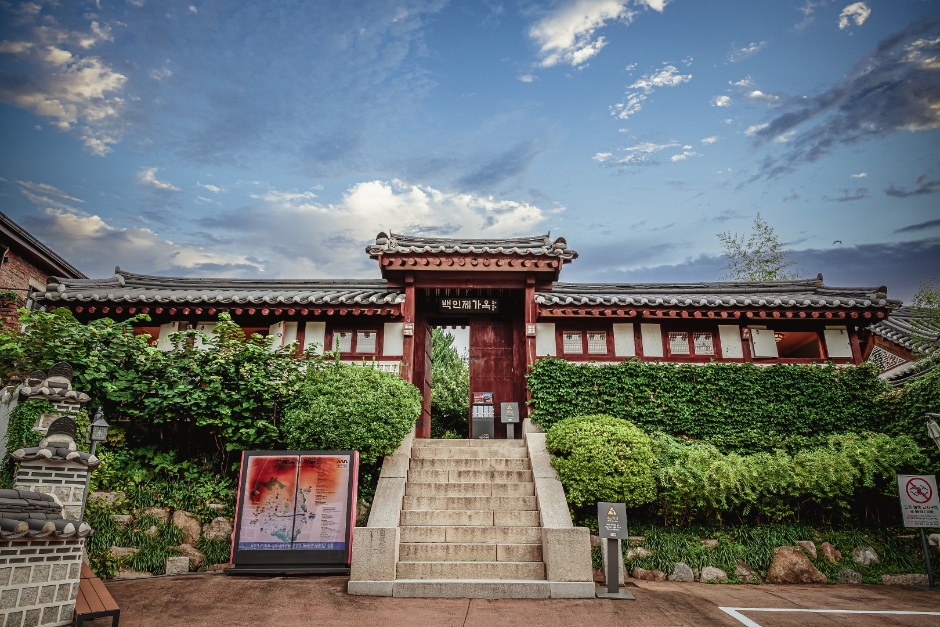
Baek In-je House (백인제가옥)
1.5Km 2025-10-24
16 Bukchon-ro 7-gil, Jongno-gu, Seoul
+82-2-724-0200
Baek In-je House, located in Bukchon Hanok Village, is a hanok built during the Japanese administration period that portrays modern hanok features. The structure consists of a main room offering a good view of the whole village, spacious bedrooms, a large garden, and annex buildings. As it maintains the beauty of a traditional hanok while incorporating the modern trend of its time, Baek In-je House is considered to be highly valuable in means of both architecture and history, representing the Bukchon Hanok Village together with Yun Bo-seon House.
Baek In-je House was built from black pine, which was first introduced in Seoul during the Gyeongseong Expo in 1907, distinguishing itself from other upper-class houses of its time. Unlike other traditional hanok designs that separate the main building from the other rooms, Baek In-je House connects the two with a hallway, allowing convenient access between the two structures. The house also consists of a Japanese-style hallway and floor mat rooms, reflecting the interior trends of that period. Baek In-je House is also unique in that the main room is partially built as a two-story structure, a style that was never seen in any traditional hanok built during the Joseon period.
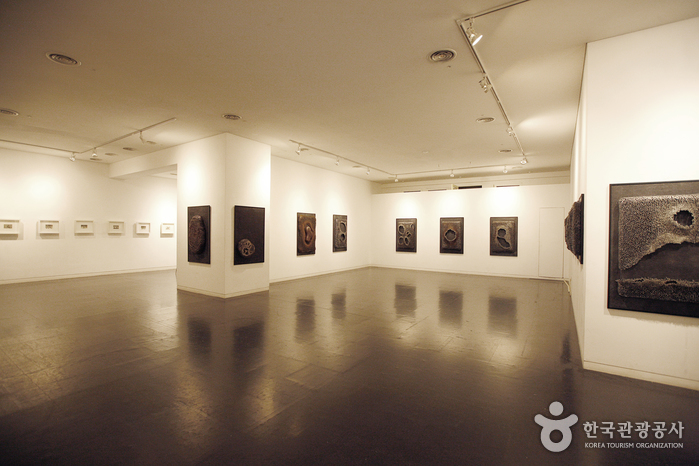
Seoul Art Center Gongpyeong Gallery (서울아트센터 공평갤러리)
1.5Km 2021-06-19
24, Insadong-gil, Jongno-gu, Seoul
+82-70-4214-0070
Opened in 1992, Seoul Art Center Gongpyeong Gallery is a 17,791㎡, two-story building with four exhibition halls. It is one of the main galleries of Insa-dong, displaying diverse artwork ranging from Western and Korean paintings to sculptures. Due to the great interest in Korean paintings, 2~3 of the annual long-term exhibitions focus solely on them.
 English
 한국어
한국어 日本語
日本語 中文(简体)
 Deutsch
 Français
 Español
 Русский


