![Note Plastic Surgery [Tax Refund Shop] (노트성형외과의원)](http://tong.visitkorea.or.kr/cms/resource/51/3314051_image2_1.jpg)
Note Plastic Surgery [Tax Refund Shop] (노트성형외과의원)
5.1Km 2024-06-27
563, Gangnam-daero, Seocho-gu, Seoul
-
![Etonne Plastic Surgery [Tax Refund Shop] (에톤성형외과의원)](http://tong.visitkorea.or.kr/cms/resource/06/3313206_image2_1.jpg)
Etonne Plastic Surgery [Tax Refund Shop] (에톤성형외과의원)
5.1Km 2024-06-26
563, Gangnam-daero, Seocho-gu, Seoul
-

DL Plastic Surgery (디엘성형외과의원)
5.1Km 2025-10-23
(4th Floor, Peyto Plaza), 563 Gangnam-daero, Seocho-gu, Seoul
DL Plastic Surgery is a premier clinic specializing in advanced procedures such as facial contouring and rhinoplasty. Our highly skilled medical team, with over ten years of experience, is dedicated to delivering the results you desire. We carefully plan and customize each surgery, ensuring that the overall harmony and balance of your face are maintained.
Your confidence and satisfaction are our top priorities. To reinforce this, we’ve implemented a surgical liability guarantee system, providing you with added trust and peace of mind regarding your results. We remain at the forefront of innovation through ongoing academic engagement and the latest research.
Note Plastic Surgery (노트성형외과의원)
5.1Km 2025-10-23
(12th-15th Floors, Peyto Plaza Building), 563 Gangnam-daero, Seocho-gu, Seoul
Note Plastic Surgery opened in Nonhyeon Station, between Gangnam Station and Sinsa Station in Seoul, in August 2019, and has just passed 4 years and is now celebrating its 5th year.
In July 2024, the Breast & Body Contouring Center and Facial Contouring Center were expanded and reopened.
KstarROAD 한류스타거리 (KstarROAD Hallyu Star Road)
5.1Km 2024-03-05
394, Apgujeong-dong, Gangnam-gu, Seoul
The K-Star ROAD is a place to meet the stories of celebrities who were at the forefront of the K-Wave phenomenon. The road features art toy statues inspired by K-Pop bands, such as SNSD, EXO, and TVXQ, while terminals next to shops help you find the fashion shops and restaurants frequented by celebrities. Moreover, the schools attended by the celebrities, houses in which they used to live, and other spots that capture their stories can also be found on this street.
Sewoon Plaza (세운상가)
5.1Km 2025-12-16
159 Cheonggyecheon-ro, Jongno-gu, Seoul
Makercity Sewoon is Korea's first comprehensive electronics market, established in 1968 and has a 40-year history. As a mecca in the urban electronics industry area located in Jongno, the center of Seoul, you can purchase various electronic products here.
Since 2014, Seoul's urban regeneration project has been underway, and a pedestrian overpass, rooftop observatory, plaza, and Makers Cube, where you can experience the 4th industrial revolution, have been created to provide unique attractions.
◎ Travel Information to Discover Hallyu’s Charm - K-Drama "Vincenzo (2021)"
"Vincenzo" depicts the story of Vincenzo (Song Joong-ki), an Italian mafia lawyer who teams up with the tenants of “Geumga Plaza” to protect a hidden stash of gold in the building from a powerful force. The building appearing as “Geumga Plaza” in the drama is none other than Seoul's Sewoon Plaza. Its retro-style aesthetic adds a unique ambience to the show and makes its scenes even more memorable.
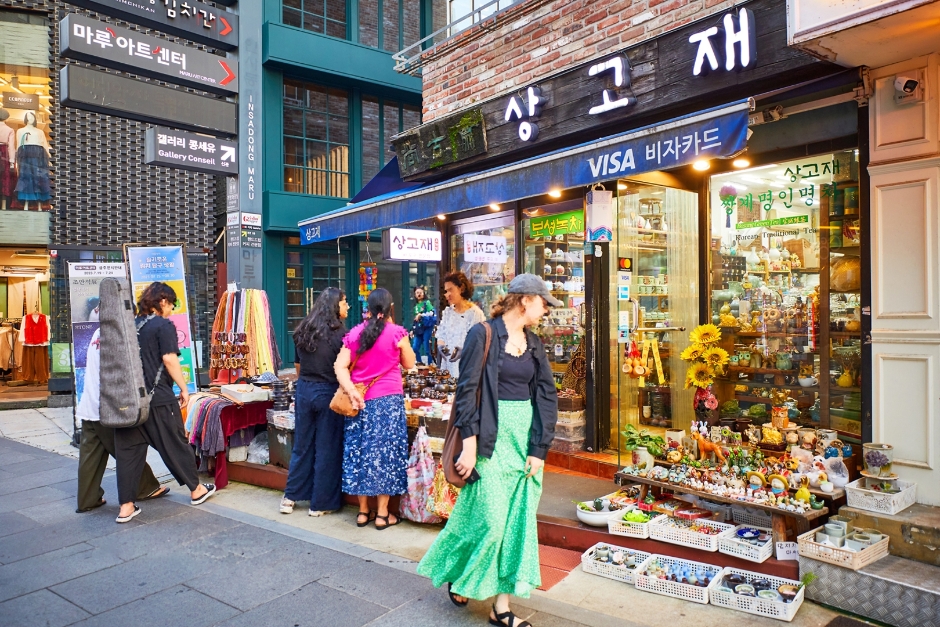
Insadong Cultural Street (인사동 문화의 거리)
5.1Km 2023-12-26
Insa-dong, Jongno-gu, Seoul Metropolitan City
Insadong Cultural Street is a popular tourist destination for visitors from all around the world, thanks to its numerous art galleries, restaurants serving Korean table d’hote, traditional teahouses, and street vendors lining the streets. Its most recognizable feature is the use of Hangeul (Korean script) in storefronts, which allows the visitors to really see just what makes this place so special. Unlike the nearby Ikseon-dong Hanok Street, Insadong Cultural Street has larger streets with wider stores, so it is much easier to traverse. On evenings and weekends, one can find buskers performing on the side of the road.
![Meilijie - Garosu Branch (No. 2) [Tax Refund Shop] (메이리지에 가로수2호)](http://tong.visitkorea.or.kr/cms/resource/49/2879749_image2_1.jpg)
Meilijie - Garosu Branch (No. 2) [Tax Refund Shop] (메이리지에 가로수2호)
5.1Km 2024-04-22
1F, 16, Garosu-gil, Gangnam-gu, Seoul
-
MODEUNMO Clinic (모든모의원)
5.1Km 2025-10-23
2nd–4th Floors, 57 Nonhyeon-ro 151-gil, Gangnam-gu, Seoul
Through many years of practice in non-incisional hair transplantation, we have devoted ourselves to creating a more systematic, customized surgery process and a more comfortable and satisfying treatment environment.
At MODEUNMO Clinic, which exclusively researches and performs non-incisional procedures, we strive to ensure your hair remains full and natural over time through truly proper hair transplantation.
Seodaemun Prison History Museum (서대문형무소역사관)
5.1Km 2024-12-02
251 Tongil-ro, Seodaemun-gu, Seoul
Seodaemun Prison was built under the Japanese administration to imprison independence movement activists. It first opened on October 21, 1908 under the name Gyeongseong Prison. Eventually, so many activists were imprisoned that the building had to be expanded. At that time, the name changed to Seodaemun Prison on September 3, 1912. Eighty years later, the prison was turned into Seodaemun Independence Park on August 15, 1992 to commemorate the Korean patriots who were tortured in prison, giving their lives for freedom. Of the many buildings, only seven were preserved for their historical significance, among which three prison buildings and the execution site were designated as a Historic Site. In 1998, the park underwent another transformation into today's Seodaemun Prison History Hall to educate the public on the importance of Korea's independence and the sacrifices of those who fought to achieve it.
 English
 한국어
한국어 日本語
日本語 中文(简体)
 Deutsch
 Français
 Español
 Русский


