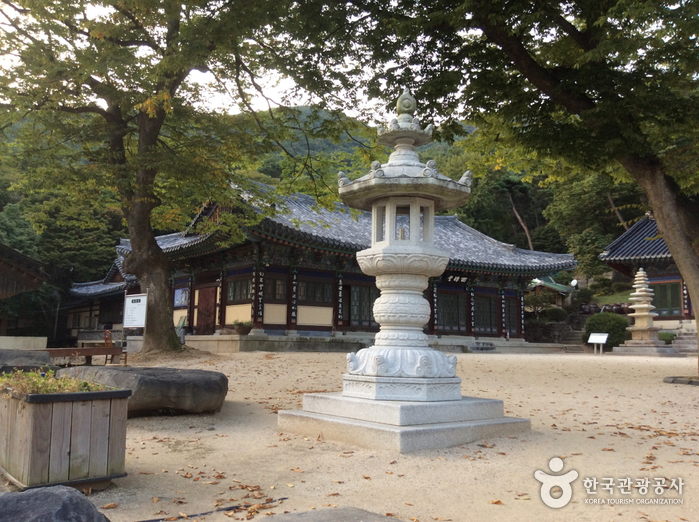
Yesan Hyangcheonsa Temple (향천사(예산))
17.3Km 2021-04-29
117-20, Hyangcheonsa-ro, Yesan-gun, Chungcheongnam-do
+82-41-335-3556
Hyangcheonsa Temple is an old temple that was founded by Monk Euigak in the late Baekje period under King Uija's rule. The temple is easily accessble from downtown despite its location deep within a valley at the foot of Geumosan Mountain, serving as a landmark for visitors enjoying a light stroll or a hike up to the mountain. Serving as a home to several relics and a nine-story stone pagoda, the temple site and buildings are well maintained and neatly cleaned on a daily basis.
According to legends, Monk Euigak originally had planned on building a temple in Sinam-myeon in Yesan. He went to China and brought a Buddha statue, praying earnestly on his way back aboard a boat. Upon his arrival, he sighted a pair of golden crows flying above the boat and followed the birds before they disappeared. He found the birds at the temple's current location, drinking from a puddle of water that had an aromatic smell. From then on the mountain was called Geumosan, meaning "the mountain of golden crow," and the temple was named Hyangcheonsa, meaning "the temple of fragrant water."

Sejong Cheongansa Temple (청안사(세종))
17.8Km 2025-05-20
128-23, Ganeusil-gil, Jeonui-myeon, Sejong-si
+82-44-867-3407
Sitting at the foot of a mountain near Ganeusil Village, Cheongansa Temple belongs to the Jogye Order of Korean Buddhism. It had been believed to have been built in 1900, but the roof tile and white porcelain pieces from the mid-Joseon dynasty period found near the temple suggested that it might have been built even earlier. Cheongsansa had also been thought to be a branch of Biamsa Temple, which is presumably built in the 7th century during the late Baekje kingdom period.

Yesan Jangteo Three Kingdoms Festival (예산장터 삼국축제)
18.4Km 2025-10-23
Yesan-ri, Yesan-eup, Yesan-gun, Chungcheongnam-do
+82-41-332-4317
The Yesan Jangteo Three Kingdoms Festival revolves around three themes: chrysanthemums, Korean rice soup, and noodles. Visitors can enjoy a variety of foods and experience the culture unique to Yesan Market.
![GRAND MOTEL [Korea Quality] / 그랜드모텔 [한국관광 품질인증]](http://tong.visitkorea.or.kr/cms/resource/89/3042989_image2_1.jpg)
GRAND MOTEL [Korea Quality] / 그랜드모텔 [한국관광 품질인증]
18.6Km 2023-12-04
1344 , Chungseo-ro, Yesan-gun, Chungcheongnam-do
+82-41-334-8934
Grand Motel, in a charming rural village in Yesan-gun, Chungcheongnam-do, is a lodging house run by a rising poet. It offers a choice of rooms: standard rooms, either bedroom-style or Korean ondol-style; or a special room equipped with a desktop PC. Each room has a bathtub to soothe travellers’ fatigue, and there is a lovely ‘healing garden’ with a grass lawn and flowers. Breakfast is not provided, but ramen is always available. Connections are good, with Janghangseong Sinryewon Station and Yesan BusTerminal close by; while local attractions Chusa House and Sudeoksa Temple are 10 - 20 minutes by car.
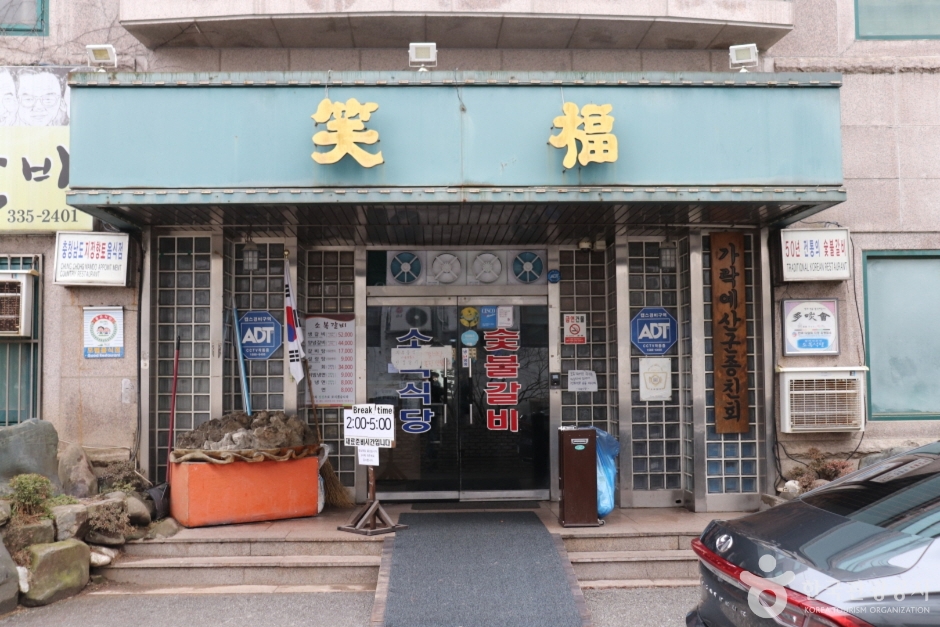
Sobok Galbi (소복갈비)
18.7Km 2024-02-28
9, Cheonbyeon-ro 195beon-gil, Yesan-eup, Yesan-gun, Chungcheongnam-do
Sobok Galbi is a fourth-generation Korean beef galbi restaurant in Yesan. It has seen many customers over its history, including even the presidents of Korea. Its signature menus are saenggalbi (grilled galbi) and yangnyeom galbi (grilled marinated galbi). Yangnyeom galbi (grilled marinated galbi) takes bone-in galbi, which is marinated in sauce for 3 days and grilled on fine charcoal quickly to seal the juice and enrich the savory flavor. Saenggalbi (grilled galbi) is grilled without any marinade. Other menus include galbitang (galbi soup), seolleongtang (ox bone soup), and naengmyeon (cold buckwheat noodles). Gulhoe (raw oysters) is only offered during winter.
Yesan Market & Yesan Fifth-day Market (5th & 10th) (예산시장 / 예산오일장(5, 10일))
18.8Km 2024-06-05
967 Hyeongjegogae-ro, Yesan-eup, Yesan-gun, Chungcheongnam-do
The city of Yesan is home to two notable markets: Yesan Fifth-day Market, which dates back to the 1920s, and Yesan Market, a permanent traditional market. Yesan has historically been a prolific producer of agricultural and livestock products, and the market served as a central point of regional specialties. In fact, Yesan apples are famous across Korea. On days ending with 0 and 5, a fifth-day market is held, which makes the market far larger and livelier. Yesan Rice Soup Street can also be found here.
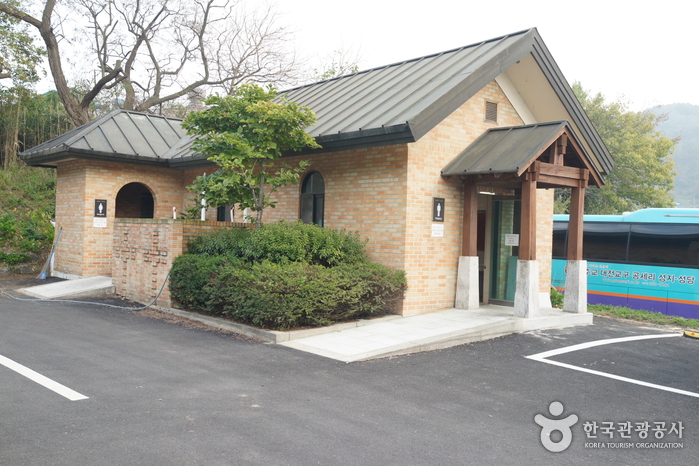
Gongseri Catholic Church (아산 공세리성당)
19.0Km 2025-10-23
10, Gongseriseongdang-gil, Asan-si, Chungcheongnam-do
+82-41-533-8181
Gongseri Catholic Church was founded in 1894 as the main parish of the Daejeon diocese in Gongse-ri, Inju-myeon that connects Asanman Bay to Sapgyocheon Stream. Early missionaries originally used a common house for church meetings in the early years until in 1897 when a rectory was built, followed by the establishment of the main church in 1922. This was the first Catholic church in Chungcheongnam-do and the religion spread across Anseong, Onyang, and Dunpo to establish regional churches respectively. The grounds have three graves of prosecuted martyrs, a parish and rectory, retreat house, and meeting room. The premises is surrounded by beautiful views of a lush forest.
Unjusanseong Fortress (운주산성)
19.1Km 2021-08-31
Migok-ri, Sejong-si
+82-44-300-3423
Unjusanseong Fortress, also known as Gosansanseong Fortress, is a cultural heritage of the Baekje dynasty. This is a mountain fortress built along the surrounding three mountain peaks in the westernmost and southernmost parts of Unjusan Mountain. The stone fortress wall, which borders three villages in Jeondong-myeon and two villages in Jeonui-myeon, is 3,210 meters long and two meters wide with a x_height that ranges from two to eight meters. The walls follow the natural geographical features of the mountain range, with the southern walls surrounding the mountain's peak.
Remnants of a village can still be observed within the fortress walls, such as the fortress gate and a ritual site. Pieces of earthenware from the Baekje period, porcelain from the Goryeo and Joseon periods, and broken tiles from the Baekje, Goryeo and Joseon periods have been discovered around the site as well.
Geumisanseong Fortress (금이성)
19.2Km 2025-05-20
Songseong-ri, Sejong-si
+82-44-300-3444
Geumiseong is a mountain fortress built on the summit of Geumseongsan Mountain, which rises 430 meters above sea level. It overlooks Jeonui and Cheonan to the north and Geumgang River to the south. The architecture style of Geumiseong Fortress is a combination of the
styles of the Baekje dynasty and the early Unified Silla. Based on the relics found inside the fortress, it is thought to have been built in the Goryeo period. The robustness of the fortress takes advantage of the rugged topography, so much so that it had been known as ironclad bastion among common people.
The eastern side of the fortress has considerably collapsed, but the southern part is in a relatively good condition. The western and northern walls are also in bad conditions.
Some earthenware pieces were found where there once stood a watchtower. Also, some pieces of roof tiles were found where there was a fortress building in the central part of the fortress on mountain summit. The earthenware pieces are hard porcelain and soft glass wares like bowls and pots. The tile pieces mostly feature fishbone patterns in dark gray color.
![Himart - Yesan Branch [Tax Refund Shop] (하이마트 예산점)](http://tong.visitkorea.or.kr/cms/resource/41/2883341_image2_1.jpg)
Himart - Yesan Branch [Tax Refund Shop] (하이마트 예산점)
19.3Km 2024-04-16
84, Geumo-daero, Yesan-eup, Yesan-gun, Chungcheongnam-do
-
 English
 한국어
한국어 日本語
日本語 中文(简体)
 Deutsch
 Français
 Español
 Русский


