
Academia Neoconfuciana Byeongsan Seowon (병산서원) [Patrimonio Cultural de la Humanidad de la Unesco]
15.0Km 2024-05-07
Byeongsan-gil 386, Pungcheon-myeon, Andong-si, Gyeongsangbuk-do
Byeongsan Seowon es una academia neoconfuciana que fue fundada para honrar la memoria de Seong-nyong Yu (1542-1607), un personaje respetado por su carácter y por sus escrituras. En 1863, este tipo de escuelas tenían muchas libertades bajo las leyes Joseon, incluso no debían pagar impuestos y otros gastos. El río Nakdonggang está situado justo enfrente de la academia. Si se cruza, se llega hasta el monte Byeongsan.
![Aldea Hahoe de Andong (안동 하회마을) [Patrimonio Cultural de la Humanidad de la Unesco]](http://tong.visitkorea.or.kr/cms/resource/43/2654743_image2_1.jpg)
Aldea Hahoe de Andong (안동 하회마을) [Patrimonio Cultural de la Humanidad de la Unesco]
16.9Km 2024-11-19
Jeonseo-ro 186, Pungcheon-myeon, Andong-si, Gyeongsangbuk-do.
La aldea Hahoe de Andong ha preservado la arquitectura de las casas y la estructura de una aldea tradicional de la dinastía Joseon. Asimismo, hay que destacar que la aldea no fue creada en forma artificial; hay gente que realmente vive allí.
El río Nakdonggang rodea tres de los cuatro flancos de la aldea Hahoe (Material Tradicional de Importancia). La aldea lleva el nombre de Hahoe porque el río forma un remolino alrededor de la misma y también se la conoce con el nombre de Aldea del Río Circular. Al lado de la aldea crecen numerosos pinos y se extiende un llano de suave arena, y frente a este se despliegan bellísimos acantilados. Esta aldea pasó al conocimiento público por una escuela confuciana de la dinastía Joseon (1392-1910), de los maestros Gyeomam (seudónimo de Ryu Un-ryong, 1539-1601) y Seoae (seudónimo de Ryu Seong-ryong, 1542-1607), que realizaron grandes hazañas durante la Guerra de Imjin en 1592.
Gracias a que la aldea está rodeada de las montañas y el río, nunca ha sufrido una invasión. Esta es la razón porque sus casas siguen conservando sus estructuras originales. En la aldea residen 180 familias y son conocidas como el Grupo de la Aldea, pertenecientes a la familia Pungsan Ryu. Dentro de ella, hay casas que fueron designadas Tesoros Nacionales, como por ejemplo Yangjindang y Chunghyodang. Asimismo, hay material importante de tradiciones, como la Casa Hahoe Bukchon, la Casa Hahoe Namchon y Hahoe Juilje. Las casas así designadas calificadas ayudan a preservar el estado original de la aldea de la familia Ryu, especialmente sobre los pilares de referencia de Ryu Un-ryong y Ryu Seong-ryong.
La aldea Hahoe es también famosa por el exorcismo Byeolsingut, la danza de máscara y la Máscara Hahoetal. La Máscara Hahoe-Byeongsantal es la más antigua de Corea y se la usa en la Danza de Máscaras Byeolsingut. La Aldea Hahoe se volvió más popular desde la visita de la Reina Isabel II del Reino Unido en 1999, y durante este tiempo se ejecutaron muchos eventos de Danza de Máscaras.
El Festival Internacional de Danza de Máscaras de Andong tiene lugar entre fin de setiembre y principios de octubre, a lo largo de 10 días aproximadamente, dentro de la Aldea Hahoe y otras áreas designadas.
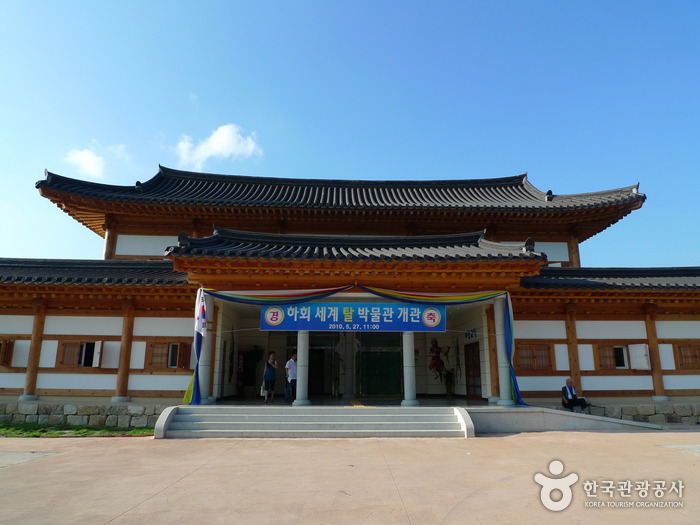
Museo de Máscaras del Mundo de Hahoe (하회세계탈박물관)
17.1Km 2024-05-14
Jeonseo-ro 206, Pungcheon-myeon, Andong-si, Gyeongsangbuk-do.
El museo se encuentra dentro de la Aldea Hahoe de Andong (Material Folclórico de Importancia). Al ser la aldea tradicional y folclórica más importante de Corea, es el lugar de origen de la máscara Hahoe (Tesoro Nacional) y de la Danza de Máscaras de Hahoe (Patrimonio Cultural Intangible). En el Museo de Máscaras del Mundo de Hahoe podrá observar no solo las máscaras Hahoe, sino también los diferentes tipos de máscaras de todas las regiones del país, exhibidas de forma sistematizada. Además, como reúne todo tipo de máscaras del mundo, tendrá la posibilidad de compararlas con las de Corea.
Entre la gran variedad de máscaras que fueron utilizadas en diferentes tipos de eventos, ceremonias y rituales, se destacan: las máscaras Bongsan, Gangnyeong y Eunnyul, que corresponden a la provincia de Hwanghaedo; las máscaras Yeongju y Songpa de Seúl; las máscaras Dongnae, Suyeong, Goseong, Gasan y Tongyeong, de la región de Yeongnam, entre otras. De entre las máscaras extranjeras están las provenientes de países africanos, de México, China, Indonesia, Nueva Zelanda, Francia, las islas Salomón, las islas Cook, etc., entre un total de 30 países.
Desde la antigüedad y hasta hoy en día, las máscaras fueron utilizadas para distintas finalidades y establecimientos: en las danzas, en las actividades médicas, en las ceremonias religiosas, en las actuaciones teatrales, en los funerales, etc., dependiendo de las costumbres y tradiciones de las naciones. Para su fabricación se ha utilizado papel, madera, piel de animales, cuero, caparazón de tortuga, huesos de animales, piedras, barro, etc., entre otros materiales. En el edificio principal está la sala de las máscaras coreanas, y en los pisos 1 y 2 del edificio anexo se encuentran las máscaras en general, tanto nacionales como extranjeras.
Aldea Yekki (예끼마을)
17.1Km 2024-05-17
Seonseong-gil 14, Dosan-myeon, Andong-si, Gyeongsangbuk-do
La Aldea Yekki está llena de callejones con coloridos murales, galerías con obras de arte de artistas locales y un centro de experiencia de casa tradicional hanok. Una actividad particularmente popular es un paseo por el Sendero Seonseongsusang-gil, que cruza el lago y ofrece hermosos paisajes.
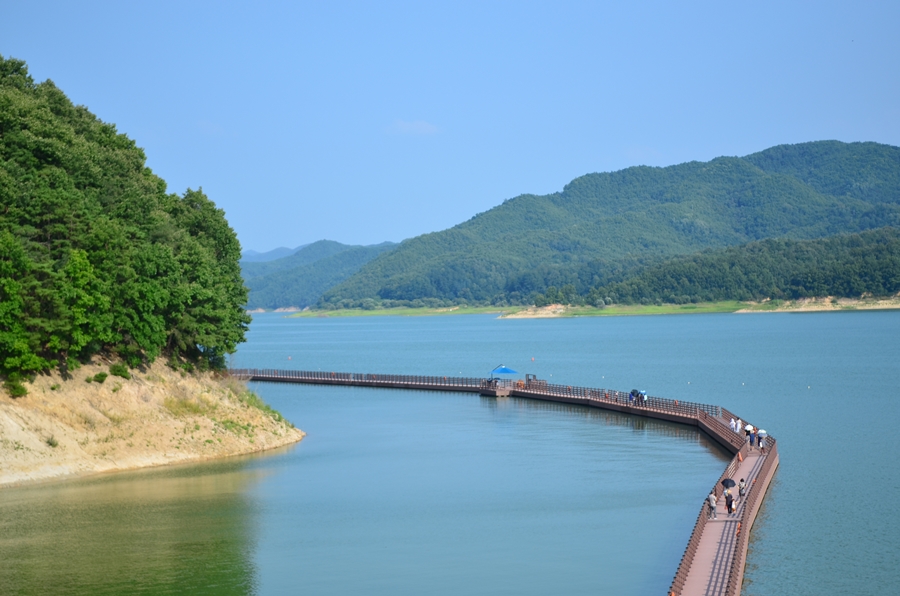
Sendero Seonseongsusang-gil (선성수상길)
17.1Km 2024-05-17
Seonseong-gil 14, Dosan-myeon, Andong-si, Gyeongsangbuk-do
El Sendero Seonseongsusan-gil de la Aldea Yekki conecta el Complejo Cultural Seonseonghyeon con el Bosque Recreativo Hoban y tiene aproximadamente 1 km de largo. Lo especial de este sendero es que la mayor parte discurre como un puente flotante sobre el lago Andong.
Acantilado Buyongdae (부용대)
18.0Km 2024-11-18
Gwangdeoksolbat-gil 72, Pungcheon-myeon, Andong-si, Gyeongsangbuk-do
Buyongdae es un acantilado de unos 64 m de altura situado al final de la cordillera Taebaeksan. Desde la cima, se puede obtener una vista panorámica de la Aldea Hahoe de Andong. Su nombre fue tomado de una historia antigua de China y significa "loto". Cerca de este lugar se encuentran los templos Ogyeonjeongsa y Gyeomamjeongsa y la Academia Neoconfuciana Hwacheon Seowon.
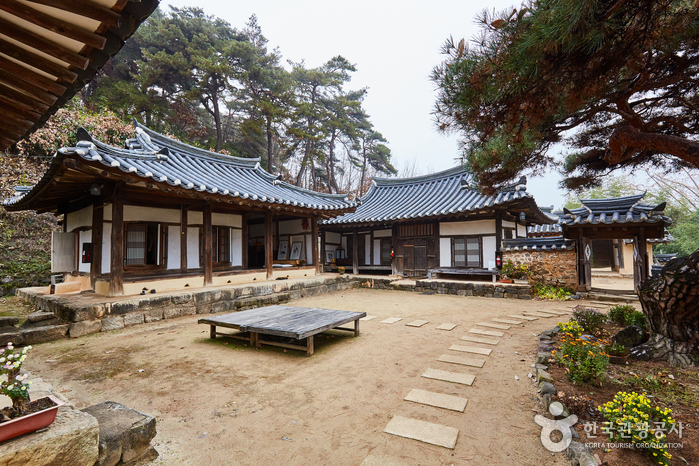
Okyeon pavilion / 옥연정사
18.0Km 2025-08-12
86, Gwangdeoksolbat-gil Pungcheon-myeon, Andong-si, Gyeongsangbuk-do
Ogyeonjeongsa House was established by Ryu Seong-yong (pen-name: Seoae, 1542-1607), a minister of Joseon, with the help of Buddhist monk Tanhong, as a place to study and educate his students. After building Wonjijeongsa House, Ryu wanted to build another house at the foot of Buyongdae Cliff amid a tranquil environment away from the village, but due to his financial situation he was unable to complete the building by himself. Then, the monk Tanhong helped him build Ogyeonjeongsa House, which took ten years (1576 to 1586) to complete, when Ryu was 45 years old. Later, Ryu Seong-yong was able to share warmth with his brother (Gyeomam), who lived in nearby Gyeomamjeongsa House. Ryu later lost his house in Hahoe in the great flood of the Nakdonggang River in 1605, and retired to Ogyeongjeongsa House where he wrote Jingbirok (The Book of Correction, National Treasure 132), a memoir of the Imjin War (Japanese Invasion of Korea in 1592). The house’s guestrooms include Sesimjae (meaning ‘having a mind to this place to achieve at least one in ten thousand things,’ inspired by the I Ching or The Book of Changes), which was used by Ryu as a schoolhouse and has two small rooms between the maru gamheonrok (wooden floor, meaning ‘looking up at the sky and down at the blue water,’ inspired by Wang Xizhi’s poetic diction); Wonlakjae (meaning ‘waiting for a friend’s visit,’ inspired by the Analects of Confucius), in which Ryu himself resided and wrote Jingbirok; and the maru aeoheon (meaning ‘I also love my hut,’ taken from a poem by Chinese poet Tao Yuanming), which measures two kan (a unit of measurement referring to the distance between two columns).
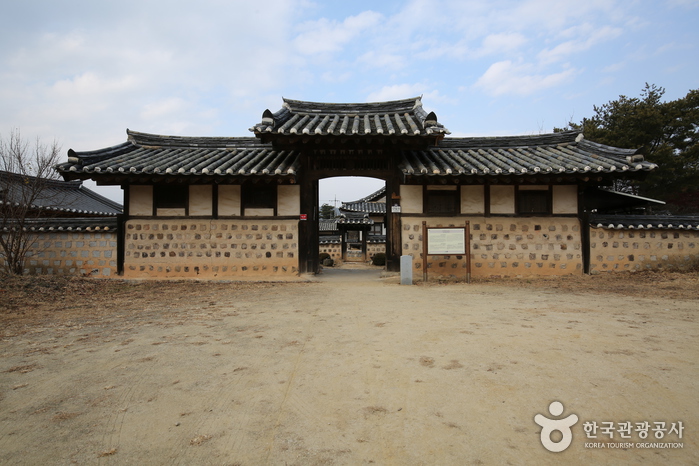
Suaedang / 안동 수애당
18.2Km 2025-08-12
1714-11, Sugogyonggye-ro Imdong-myeon, Andong-si, Gyeongsangbuk-do
'Suaedang Traditional House was built by Ryu Jin-geol, also known by his pen-name of Suae, in 1939. This hanok-style house consists of three buildings that measure 29-kan (a traditional measurement that corresponds to the space between two columns) in total.
The main room, or jeongchim (7-kan at front and 2-kan at sides), has a half-hipped roof, and forms a‘ㄱ’-shape with the storeroom (10-kan at front), which also has a half-hipped roof. Originally located at 612 Sugok-dong, Andong-si, the house was relocated from a slight slope to a flat piece of land due to the construction of Imha Dam in 1987. Consequently, the Jeongchim was rebuilt at a lower level than before.
The Suaedang was renovated by modernizing the old-style facilities including the kitchen, toilets, and washroom without changing their external features, while the rooms and daecheongmaru (main floored room) were decorated with red clay and natural paint. Suaedang, with its beautiful panoramic view of the lake, was designated as Gyeongsangbuk-do Cultural Property No. 56.
Yangjindang (하회 양진당)
18.3Km 2025-07-01
68, Hahoejongga-gil, Andong-si, Gyeongsangbuk-do
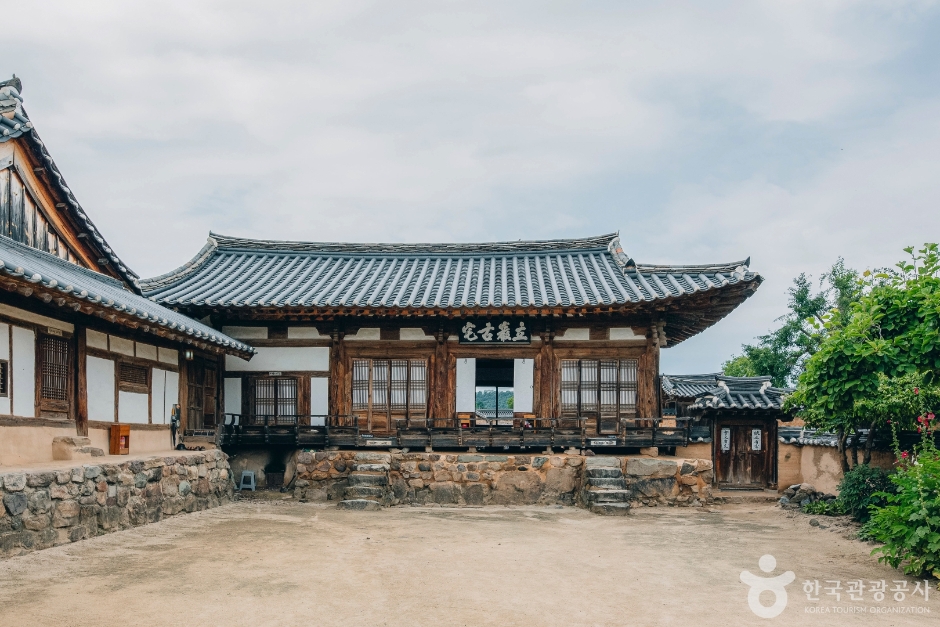
“Andonog Hahoe Yangjindang,” located in the Hahoe Folk Village, is Treasure No 306 and the residence of a family with the surname Pungsan Ryu. A tablet read Ipam Antique House, named after Ipam Ryu Jung Yeong (1515 - 1573), is hung on the entrance. Yangjindang is named after the nickname of Ryu Yeong (1687 - 1761), the sixth generation of Gyeongam Ryu Un Ryong, son of Ipam. The name means “nourishing well one's own nature.” The Hanok stands over the entrance, with a well-polished floor that is grand yet friendly. One of the characteristics of the house is that it includes Sarangcha or detached building, which reflects the architecture from the Goryeo period, and Anchae or main building in the architecture style from the Joseon period.
It is expected that such co-existence was made possible because of the repairs done after Imjin War. How fortiunate that the antique house has been preserved until now! The well-tended garden shows the commitment of the descendants to maintaining the space. Rooms are rather simple compared to the grand exterior of the house. Traditional mother-of-pearl furniture, tableware in the cupboard, randomly ceramics placed draw attention. The house resembles a small folk museum. Why not enjoy some traditional folk games during your stay? There is a variety of play tools such as yut, tuho, jegi, tops, and kites. Experience programs such as gayangju brewing, rice cake and traditional dessert making, and flower tea are conducted by the first daughter-in-law of the house, depending on the season.
 Español
 한국어
한국어 English
 日本語
日本語 中文(简体)
 Deutsch
 Français
 Русский


