Maru-O (마루오) - Los alrededores - información de viajes Corea

Maru-O (마루오)

Maru-O (마루오)

15.8Km    2025-07-18

5-8, Baemet 3-gil, Naju-si, Jeollanam-do

Maru-O is a business hotel in the heart of Naju Innovation City, Jeollanam-do, that has good facilities and is popular with both business travellers and tourists. The underground parking lot has an electric vehicle charging station, and both mobile phone chargers and tourist information for Naju and Jeonam is available at the front desk. Right in front of the hotel is Bitgaram Lake Park where visitors can take a pleasant walk. Naju KTX station and the Intercity Bus Terminal are 15 minutes away by car, and Naju’s Yeongsanpo Hongeo Street and Gomtang Street (famous for its restaurants!) are also nearby.

Río Yeongsangang (영산강)

Río Yeongsangang (영산강)

16.3Km    2021-08-26

Gaedongsingi-gil, Subuk-myeon, Damyang-gun, Jeollanam-do.

El río Yeongsangang (136 km) es uno de los cuatro principales ríos de Corea. Se trata del más pequeño de los cuatro (los otros tres son el río Hangang de 482 km, el río Nakdonggang de 522 km y el río Geumgang de 396 km de largo). El río nace en el pico Yongchubong (560 m) localizado en Yong-myeon, en el municipio de Damyang-gun, provincia de Jeollanam-do. Su recorrido transcurre por Damyang, Gwangju, Naju y Yeongam y finalmente desemboca en el Mar Amarillo cerca de Mokpo.

El río sufre de algunos retos ambientales, y algunos acontecimientos meteorológicos extremos han causado inundaciones con la pérdida de ecosistemas y la degradación del hábitat. En diciembre de 1981 se construyó una presa y los daños se redujeron. El gobierno coreano también ha implementado el Proyecto de Restauración de los Cuatro Mayores Ríos desde 2009 con el objetivo de restaurar los ríos y al mismo tiempo desarrollar las regiones. Bajo este proyecto, se invirtió mucho dinero por tal de solucionar los problemas del río Yeongsangang.

Sane Flower (산에는 꽃이피네)

17.2Km    2025-07-18

20-1, Dongnyeok-gil, Naju-si, Jeollanam-do

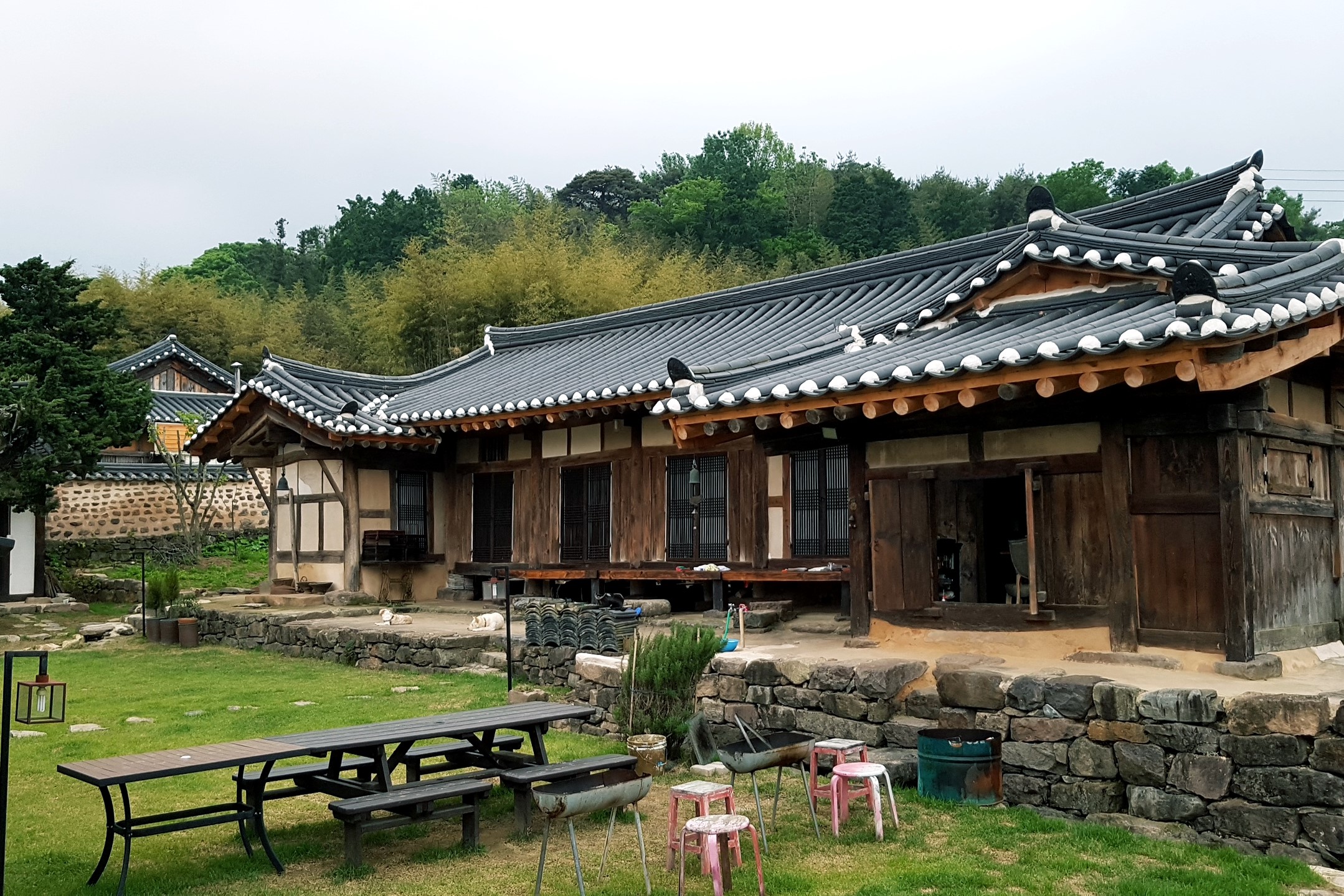
Sane Flower in Dorae Hanok Village, Naju-si, Jeollanam-do, is a 100 year-old house built in the traditional way using local timber and no nails. Guestrooms are well insulated and equipped with bathroom and kitchen. Interiors are lined with Korean paper and are old-time and cozy. There’s a wooden veranda from which visitors can see the fine old maple tree in the yard. Among other local attractions, Naju’s Redwood Road is nearby, offering guests a peaceful walk in the woods;  some weekends, the owner offers neighbourhood guided tours.

Doraemi House (도래미하우스)

17.3Km    2025-07-18

18-26, Dongnyeok-gil, Dado-myeon, Naju-si, Jeollanam-do

Doraemi House in Dorae Village, Naju, Jeollanam-do, is a hanok stay with a bonchae (‘main house’), a sarangchae (men’s house) and a byeolchae (‘reception room’). The bonchae has two bedrooms with a hidden attic space. The sarangchae has a living room with bedrooms on either side; while the byeolchae, atop a low hilll, has a single cozy room. A walk along a forest road takes you to a pavilion by a pond. Next to the bonchae is a quiet and tranquil reading room.

Changpyeong en Damyang (Cittaslow) (전남 담양 창평 [슬로시티])

17.5Km    2021-04-16

Doldam-gil 56-24, Changpyeong-myeon, Damyang-gun, Jeollanam-do.
+82-2-383-3807

Changpyeong-myeon es una región de cultivos muy agradable para vivir. Las industrias suburbanas de tomates, fresas y vegetales tienen un gran funcionamiento junto a la bien preservada naturaleza. Este lugar tiene mucho potencial. El nombre Changpyeong se ha utilizado desde el inicio de la dinastía Goryeo, y era famoso para formar a muchos funcionarios del gobierno que eran leales al país, a los padres y la cortesía. El famoso caramelo de arroz de Changpyeong y los dulces que se presentaban a los reyes de la dinastía Joseon, la sal de bambú con un misterio de mil años de antigüedad, la pasta de sal de frijoles de bambú, el tteokgalbi tradicional no son solo alimentos sino también el orgullo de Changpyeong.

* Historia

Durante el período de los Tres Reinos, se llamaba Gugyeguk. Durante el período Baekje, se llamaba Guljihyeon. Durante el período Silla, se llamaba Giyanghyeon en el año 757. Durante el período Goryeo, se llamaba Changpyeongphyeon en el año 940, y el mayor cuerpo de gobierno conocido Hyeonnyeong fue estableció en 1144. Durante el período Joseon, en 1479 (5º año del reinado de Seongjong), Changpyeonghyeon fue trasladada y subyugada a Gwangjumok. Fue renombrada a Changpyeonghyeon en 1479 después de Kim Yu San. En 1758 (34º año del reinado de Yeongjo), Min Baek Rok recopiló diarios de Changpyeonghyeon, y en 1793 (17º año de reinado de Jeongjo) el distrito juez de Changpyeonghyeon, Jo Gwang Jon movió de Goseo-myeon, Goeup-ri para Changpyeong-myeon, Changpyeong-ri, 82-bunji. El 26 de mayo de 1895, se convirtió en Namwon-bu, Changpyeong-gun. El 24 de agosto de 1896, se convirtió en Changpyeong-gun de Jeollanam-do con 9 distritos. Durante la colonia japonesa, en 1910, fue Changpyeong-gun, y el 28 de febrero de 1914, según la orden del ministerio nº 11, fue incorporado a Damyang-gun y renombrado Changpyeong-myeon.

※ Hay una teoría según la cual Changpyeong fue conocida como Changpyeonghyang (lugar de nacimiento de Confucio) por sus similitudes geográficas. El 1° de abril de 1990, Nam-myeon Oedong-ri fue incorporada a Changpyeong-myeon.

Aldea Samjinae de Changpyeong en Damyang (Cittaslow) (담양 창평 삼지내마을[슬로시티])

Aldea Samjinae de Changpyeong en Damyang (Cittaslow) (담양 창평 삼지내마을[슬로시티])

17.8Km    2021-06-25

Doldam-gil 9-22, Changpyeong-myeon, Damyang-gun, Jeollanam-do.

La Aldea Samjinae es una zona residencial formada en 1510. En su parte este hay una montaña llamada Wolbongsan, y desde el famoso pico Guksubong del sur se puede observar la entera aldea. Su nombre significa “Aldea en el seno de un fénix”. Por poseer buenos terrenos, desde la antigüedad sus habitantes practicaron la agricultura, y hasta ahora se producen excelentes frutos de la tierra. Muchas casas tradicionales hanok se conservan en perfecto estado.

Gotaekhanok / 고택 한옥에서

Gotaekhanok / 고택 한옥에서

17.8Km    2025-08-12

88-9, Doldam-gil Changpyeong-myeon, Damyang-gun, Jeollanam-do
+82-61-382-3832

Hanok Pension is an old traditional Korean house located in Samjinae Village, Changpyeong-myeon, Damyang-gun, the first village in Asia to be listed as a 'Slow Village.' It has 15 guestrooms in traditional Korean house buildings along a stone-wall road just like in the old days in Korea. The guesthouse is conveniently located for those planning to visit Juknokwon (Bamboo Garden) and Metasequoia Street, which is regarded as the most beautiful street in Korea, because they are all within 30 minutes away from the guesthouse on foot. The old traditional Korean house consists of one main building and two detached buildings, between which is a large front yard. The two detached buildings are divided into different sections for the guests to stay in. You will see lots of different wild flowers in and around the premises. The tea room is another popular feature of the guesthouse because of the calming atmosphere.

3917 Majung / 3917 마중

3917 Majung / 3917 마중

18.1Km    2025-08-13

42-16, Hyanggyo-gil, Naju-si, Jeollanam-do

Located in Gyo-dong, Naju-si, Jeollanam-do, 3917 Majung is a cultural space combining a hanok (traditional Korean house) cafe, modern cultural experiences, and hanok guesthouse. The name “3917 Majung” refers to its goal of “welcoming (majung) the modern culture of Naju in 1939 anew in the year 2017.” Spread out on a wide land area of 13,223 m2 are four buildings of Nanpajeong, Sarangchae, Mokseowon, and Siseoheon. All buildings take after the unique combination of Japanese- and Western-style housing commonly seen in the late Korean Empire period.
Nanpajeong is a pavilion constructed during mid-Joseon period, named after its most famous guest Jeong Seok-jin (pen-name: Nanpa), a scholar who led an uprising against Japanese imperialism in late Joseon period. There are two ondol (under-the-floor heating system) rooms in total, separated by a central wooden-floor hall (daecheong), one supporting 3 to 4 guests, one ideal for 2 to 3 guests. The restroom, which is also fitted with a shower booth, is located outside the building.
Eunhaengmok Room 1 and 2, which are housed in the Sarangchae building, are tatami rooms with balcony. Sarangchae’s shower and restroom is located in the building. Mokseowon is likewise made up of three tatami rooms, separated by open floor space and an attic. The shower and restroom is located outside the building. Siseoheon houses a 4-person room and the largest room in the complex, capable of supporting more than 10 guests. There are 2 restrooms and 2 restrooms with shower facilities, making the building ideal for group events.

Festival de Flores Gildong de Jangseong (장성 황룡강 길동무 꽃길 축제)

Festival de Flores Gildong de Jangseong (장성 황룡강 길동무 꽃길 축제)

18.5Km    2025-03-31

Jangjae-gil 21, Jangseong-eup, Jangseong-gun, Jeollanam-do
061-390-7252

El festival es una celebración de Hong Gil-dong, un famoso héroe en las novelas clásicas coreanas. Hay zonas para tomarse fotografías, fuentes musicales y lugares para visitar de noche.

Yacimiento de Dólmenes de Hwasun (화순 고인돌군 유적) [Patrimonio Cultural de la Humanidad de la Unesco]

Yacimiento de Dólmenes de Hwasun (화순 고인돌군 유적) [Patrimonio Cultural de la Humanidad de la Unesco]

19.3Km    2022-04-07

Hyosan-ri 64, Dogok-myeon, Hwasun-gun, Jeollanam-do.

El Yacimiento de Dólmenes de Hwasun está situado cerca de las cascadas de la cordillera que une Hyosan-ri de Dogok-myeon y Daesin-ri de Chunnyang-myeon. Según diversos estudios, 135 de las 980 rocas de Hyosan-ri en Dogok-myeon son dólmenes. También hay unas 100 rocas planas que aún mantienen su forma. En Daesin-ri de Chunnyang-myeon hay unos 124 dólmenes, de entre 3.309 rocas. Hay al menos 300 que mantienen su forma, y 23 dólmenes fúnebres. Lo que hace especiales los dólmenes de Hwasun es su abundancia, con 596 dólmenes en este pequeño distrito, incluyendo la mayor losa de Corea. El Yacimiento de Dólmenes de Hwasun fue registrado como el Patriminio Cultural de la Humanidad por la Unesco el 2 de diciembre de 2000, junto con los yacimientos de Gochang y Ganghwa.